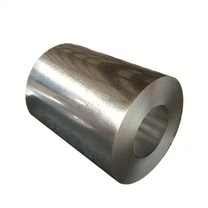
What Is Hot-Dip Galvanized Steel Coil?
Hot-dip galvanized steel coil is a steel sheet product with a layer of zinc coated on the surface of a ferrous substrate to improve corrosion resistance and extend service life. From the viewpoint of the process characteristics of hot-dip galvanizing, its corrosion resistance is superior to other coating processes: the zinc-iron alloy layer formed by the process is more compact and finer, effectively blocking air and water, reducing the possibility of oxidation and significantly extending the service life of the steel.
1. Triple Protective Layer Technology
Using the continuous hot-dip coating process (CGL), the zinc layer thickness can be customized from 30 to 275 g/m² to meet different corrosive environments:
Outer layer: pure zinc protective layer (resistant to mechanical damage).
Middle layer: zinc-iron alloy layer (chemical stability).
Base layer: high-strength steel substrate (load-bearing core).
2. Surface Finish and Appearance
Surface finish: typical surface roughness Ra ≤ 0.8 μm, verified with profile comparators such as those referenced in ISO 8503-2.
Three appearances: no zinc spangles, small zinc spangles, and regular zinc spangles.
Passivation: chromate or chromium-free passivation can be selected per the application; chromium-free passivation meets modern environmental requirements (for example RoHS) that restrict hexavalent chromium.
3.Why the Zinc-Iron Alloy Layer Matters
During hot-dip galvanizing, the zinc reacts with the steel surface to form a zinc-iron intermetallic layer. This layer is dense, tightly bonded and chemically stable, providing both adhesion for the outer zinc layer and long-term protection even where the surface is scratched, while the outer zinc layer also gives sacrificial (cathodic) protection.
Applications
Galvanized coils are used in construction (roofing, wall panels, purlins), home appliances (washing-machine shells, air-conditioner housings), vehicles, electrical cabinets, furniture and general industrial fabrication where corrosion resistance and formability are required.
|
Name |
Galvanized Coil |
|
Standard |
EN10147,EN10142,DIN17162,JIS G3302,ASTM A653,JISG3302,ASTM A653M, EN10327,DIN17162,EN10142,EN10292 |
|
Grade |
DX51D,DX52D,DX53D,DX54D,S220GD,S250GD,S280GD,S350GD,S350GD,S550GD, SGCC,SGHC,SGCH,SGH340,SGH400,SGH440,SGH490,SGH540,SGCD1,SGCD2,SGCD3, SGC340,SGC490,SGC570,SQ CR22(230),SQ CR22(255),SQ CR40(275),SQ CR(340),SQ CR80(550),CQ,FS,DDS,EDDS,SQ CR33(230),SQ CR37(255),SQ CR40(275),SQ CE50(340),SQ CR80(550) or Customer's Requirement |
|
Thickness |
0.12-3.00mm or customer's requirement |
|
Width |
100mm-1500mm according to customer's requirement |
|
Type of Coating |
Hot Dipped Galvanized Steel(HDGI) |
|
Zinc Coating |
30-275g/m² |
|
Surface Treatment |
Passivation(C),Oiling(O),Lacquersealing(L),Phosphating(P),Untreated(U),Galvanized,PVC,Black and color painting,transparent oil,anti rust oil |
|
Packing |
Water proof paper is inner packing,galvanized steel or coated steel sheet is outer packing,side guard piate,then wrapped by seven steel belt or according to customer's requirement |
Request Latest Steel Price Today
Frequently Asked Questions
Q: What are the advantages of hot-dip galvanizing over other coating methods?
A: Hot-dip galvanizing forms a metallurgically bonded zinc-iron alloy layer plus a pure zinc layer, giving strong adhesion, sacrificial protection and long service life compared with painted or electroplated coatings.
Q: What does the zinc coating weight mean?
A: It is the mass of zinc per square meter measured on both sides (for example Z275 = 275 g/m² total); a heavier coating means longer corrosion protection.
Q: What is the difference between DX51D, DX52D and DX53D?
A: They are successive formability grades under EN 10346: DX51D for general forming, DX52D for drawing, and DX53D for deep drawing with higher elongation; higher numbers mean better formability.
Q: Is chromate passivation allowed under RoHS?
A: RoHS restricts hexavalent chromium, so chromium-free passivation is the compliant choice for many markets; chromate passivation may still be used where explicitly permitted.