
Galvanized steel
1. Definition & Manufacturing Process
A galvanized steel coil is a rolled steel product coated with a protective zinc layer through hot-dip galvanizing (immersing steel in molten zinc) or electro-galvanizing (electrolytic deposition of zinc).
Key process steps include:
Base Material: Cold-rolled (smooth surface) or hot-rolled (higher strength) steel strips.
Coating Types:
Pure Zinc Coating: Standard corrosion resistance.
Zinc-Iron Alloy Coating: Enhanced weldability and paint adhesion via post-heating treatment.
5% Al-Zn Coating: Superior electrochemical passivation and corrosion resistance compared to traditional zinc coatings.

Zinc Thickness
| Zinc Coating Grade | Zinc Coating (g/m²) | Corrosion Resistance | Typical Applications | Remarks |
| Z30 | 30 | Very low | Indoor parts, home appliance inner panels, ventilation ducts | Not suitable for outdoor use |
| Z60 | 60 |
Low |
Indoor structures, temporary facilities | Low cost |
| Z80 | 80 | Medium | Light steel structures, base metal for PPGI | Good cost performance |
| Z100 | 100 | Medium | PPGI, fencing, general construction
|
Common export grade |
| Z120 | 120 | Medium-High |
|
Longer service life |
| Z140 | 140 | Medium-High | Industrial buildings, agricultural facilities | Suitable for outdoor use |
| Z180 | 180 | High | Long-term outdoor structures, equipment housings
|
Recommended for outdoor use |
| Z200 | 200 | Very high | Humid environments, heavy structures
|
Higher cost |
| Z275 | 275 | Excellent
|
Coastal areas, solar mounting systems, high-corrosion environments | High standard |
Spangle
The "spangle" is a type of surface morphology found on hot-dip galvanized (pure zinc-coated) steel coils. When the steel strip passes through the zinc pot, its surface becomes coated with liquid zinc. As the zinc layer naturally solidifies, zinc grains nucleate and grow, forming what is known as "spangle."
The name "spangle" comes from the fact that the complete zinc crystals display a snowflake-like pattern, which is quite vivid and descriptive.

2. Key Features
Corrosion Resistance: Zinc acts as a sacrificial layer, protecting steel from oxidation and moisture.
Surface Quality: Available in bright surface finishes for aesthetic applications.
Formability: Suitable for stamping, bending, and welding.
3. Applications
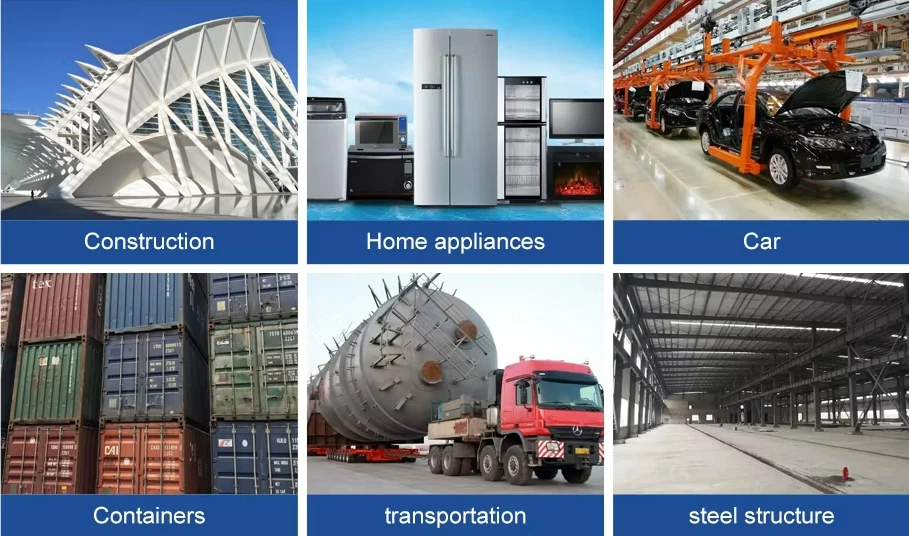
Hot-dip galvanizing and zinc iron alloy have excellent properties, such as corrosion resistance, molding, coating and so on .They are mainly used in construction, home appliances, automobile and metallurgy industries. Among them, the construction industry is mainly used for roofs, doors and windows, rolling curtain doors, ceiling keels, etc. home appliances are used for refrigerators, washing machines, etc: the automobile industry is mainly used for body shell, chassis, doors, fuel tanks, fender and so on. The metallurgical industry is mainly used for steel window billet, color coated plate substrate and so on.
Construction: Roofing, purlins, and structural components.
Automotive: Body panels, chassis parts, and repair materials.
Household Appliances: Refrigerator shells, washing machine frames.
Industrial: Pipes, containers, and furniture frameworks.
4. Advantages
Cost-Efficiency: Long service life reduces maintenance costs.
Environmental Sustainability: Fully recyclable and supports green manufacturing.
Customization: Available in varied thicknesses (base steel and zinc coating) for diverse industrial needs.
| Grade | Yield Strength/Mpa | Tensile Strength/Mpa | Elongation/% |
| DX51D+Z | ≤360 | ≤440 | ≥20 |
| Dx52D+Z | ≤260 | 330-390 | ≥28 |
| DX53D+Z | ≤200 | 270-320 | ≥38 |
| DX54D+Z | ≤180 | 270-310 | ≥40 |
| S250GD+Z | ≥250 | ≥330 | ≥19 |
| S350GD+Z | ≥350 | ≥420 | ≥16 |
| S450GD+Z | ≥450 | ≥510 | ≥14 |
| S550GD+Z | ≥550 | ≥560 | / |


