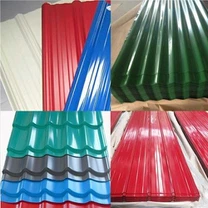
What Coated Steel Actually Is
When flat steel receives an additional layer of metallic or organic material to prevent rust, the product is called coated steel, and the coating is almost always applied while the steel is still in coil form so that the process can run continuously at high speed with tight thickness control. Coated steel divides into three broad categories: metallic coated steel such as hot-dip zinc and aluminium-zinc products, organic coated steel in which a paint or plastic film carries the protection, and tinplate for food-contact packaging. The coated coil families used in construction and appliances belong to the first two categories, and the trade abbreviations PPGI, PPGL and PPGF are simply different combinations of a metallic substrate with an organic topcoat.
The Substrate Difference Behind the Abbreviations
| Family | Metallic substrate | Substrate standard reference | Typical service |
|---|---|---|---|
| PPGI | Hot-dip zinc coating | EN 10346 Z, ASTM A653 G, JIS G3302 | General roofing, walling, appliance casings |
| PPGL | 55% aluminium, 43.4% zinc, 1.6% silicon | EN 10346 AZ, ASTM A792, JIS G3321 | Long-life roofing, heat-reflective cladding |
| PPGF | Zinc-iron alloy, galvannealed in-line | Produced from an EN 10346 or ASTM A653 zinc substrate | Parts needing paint adhesion and weldability |
The substrate determines how the coil behaves where the paint is cut. A zinc substrate sacrifices itself at a sheared edge and stops rust creep, an aluminium-zinc substrate combines barrier protection with a smaller sacrificial reserve, and a zinc-iron alloy substrate is harder and less ductile but takes paint exceptionally well and welds with less electrode wear. Zinc-aluminium-magnesium coatings are the newer addition to this family and are ordered wherever a lighter coating weight is needed for the same atmospheric life. All of them are supplied as coil with coating weights that are stated in grams per square metre over both surfaces.
Organic Coating Systems and Standards
The paint side of the product is controlled by EN 10169 for continuously organic coated flat steel, ASTM A755 for prepainted metallic-coated sheet, and GB/T 12754 for colour coated sheet and strip. Coatings divide into inorganic systems, organic systems and composite systems, and the organic group includes polyester, silicon-modified polyester, polyvinyl chloride, polyacrylate, alkyd, epoxy and fluorocarbon resins. Application follows one of two routes. The coating route uses electrostatic or air spraying followed by curing, while the lamination route presses a formed, printed or embossed polyvinyl chloride film onto the steel to produce what is often called plastic composite steel. Coil coating normally builds a conversion layer, a primer of about 5 to 7 µm and a topcoat of 18 to 25 µm, so total dry film thickness lands between roughly 25 and 32 µm for a standard polyester system.
Performance Characteristics in Use
Composite construction is the reason coated coil works so well. The steel supplies strength, rigidity and shearability; the coating supplies colour, texture and resistance to corrosion, heat, humidity and low temperature. A properly cured film has strong adhesion and survives secondary operations such as cutting, bending, roll forming, drilling and profiling without flaking, which is what allows a plant to form a finished roof panel from pre-painted coil rather than painting after fabrication. Formability limits are set by the paint system: a standard polyester film tolerates a T-bend of around 2 to 3 times the sheet thickness, while a flexible polyester or polyurethane system can be taken tighter. Impact resistance, pencil hardness and solvent resistance are the routine film tests, and colour stability under ultraviolet exposure governs the choice between polyester and fluorocarbon for exposed façades.
Applications and Selection Logic
Exterior wall panels, roof panels, indoor wainscot and ceiling panels account for the largest volume, followed by exhaust and ventilation ducts, and enclosures for household appliances where the coated surface is part of the finished appearance. Selection follows three questions. What is the exposure? A rural interior duct needs a light coating weight and a single-coat polyester, while a coastal façade needs a heavy metallic coating and a fluorocarbon topcoat. What forming will the coil see? Severe profiling calls for a flexible film and a lower T-bend rating. Will the part be welded? A galvannealed subtrate welds better than a heavy zinc coating, but the weld zone always needs a repair coat because the organic film is destroyed at the arc. The base steel grade, coating weight, paint system, film thickness, colour and gloss level all belong on the order along with the required standard.
Coil coating lines verify coating mass by gravimetric stripping and paint thickness by magnetic gauge, then test adhesion by cross-hatch, T-bend and reverse impact, and cure by solvent rub and hardness. Colour is checked against an approved standard under a defined light source, and gloss is measured at the specified angle. Coils are supplied with an inner diameter of 508 mm or 610 mm, protected by interleaved film where the surface is critical, and packaged with waterproof paper, plastic wrap and steel edge protection on non-fumigation pallets. A mill test certificate to EN 10204 3.1 reports the substrate coating weight, the paint system and the mechanical properties of the base steel for each coil.
Frequently Asked Questions
Q: How do I tell PPGI from PPGL when both look the same?
A: The difference is the metallic coating under the paint. PPGI uses a zinc coating and PPGL uses a 55% aluminium-zinc alloy coating. Coating mass test results on the certificate identify which substrate was supplied.
Q: Which coated coil is best for a coastal building?
A: An aluminium-zinc substrate with a heavy coating weight and a fluorocarbon topcoat is the usual specification, because the alloy layer resists chloride attack longer than pure zinc and the fluorocarbon film holds colour under strong ultraviolet exposure.
Q: Can coated coil be welded without damaging the finish?
A: The arc destroys the organic film and the metallic coating in the heat-affected zone, so the weld is made on stripped material and the affected area is repaired afterwards with a zinc-rich and colour-matched coating.
Q: What film thickness is normal for a prepainted coil?
A: A standard system builds 5 to 7 µm of primer and 18 to 25 µm of topcoat, giving 25 to 32 µm total dry film. Thicker systems are used for aggressive environments and are declared separately on the certificate.
Q: Does the composite coating withstand secondary processing?
A: Yes, provided the film has been specified for the operation. Shearing, bending, roll forming, drilling and profiling are all standard, and adhesion is verified by T-bend and cross-hatch tests before the coil is released.