
Key Takeaways
Galvanized coil is made on a continuous hot-dip galvanizing line: cleaning → annealing → zinc pot → air knife → cooling → skin pass → passivation → recoiling.
The air knife controls coating weight and uniformity; spangle appearance is set by bath chemistry and cooling practice.
Coating is ordered as a class (for example Z060–Z275 in g/m²) per GB/T 2518 / EN 10346.
Galvanized coil serves construction, light industry, automotive, agriculture and commercial applications.
1. Line Overview
A continuous hot-dip galvanizing line processes cold-rolled steel coil into zinc-coated coil in one pass. The substrate is uncoiled, welded end-to-end for continuity, and fed through a sequence of stations that clean, anneal, coat and finish the strip before it is recoiled. Each station sets a property of the final product - flatness, coating weight, surface finish or spangle appearance.
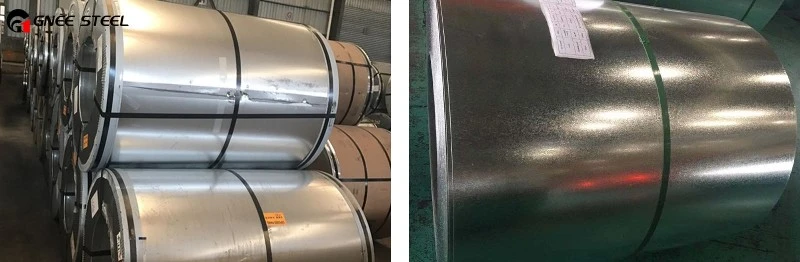
2. Step by Step
- Cleaning: the strip is alkali-degreased, brushed and rinsed to remove rolling oil and dirt, so the zinc wets the steel surface.
- Annealing: the strip is heated in a continuous furnace under a protective atmosphere (typically hydrogen–nitrogen), which reduces surface oxides and restores the recrystallised microstructure of the cold-rolled substrate.
- Zinc pot: the annealed strip enters a bath of molten zinc at about 440–460 °C; small aluminium additions control the Fe–Zn reaction and coating adhesion.
- Air knife: high-velocity gas jets wipe surplus zinc from both surfaces, setting the coating weight and its uniformity across the width.
- Cooling: the coated strip is cooled; the cooling practice also determines spangle formation (regular, minimised or zero spangle per bath chemistry and cooling rate).
- Skin pass and finishing: light temper rolling improves flatness and surface finish; passivation (chromate-free options) or oiling protects the surface during storage.
- Recoiling: the finished strip is inspected, recoiled, and cut to sheet or slit to width as ordered.
3. Coating Classes and Spangle Types
Coating is ordered as a class per GB/T 2518 / EN 10346 - for example Z060, Z100, Z140, Z180, Z275 (g/m², three-point average, both sides). Spangle types include regular (normal zinc flower), minimised (fine), flat and zero spangle; the choice is a visual and corrosion-performance decision, and is specified at order.

Spangle Types
4. Applications
Galvanized coil is used in construction (roofing panels, profiles), light industry (appliance shells, ducting), automotive (corrosion-resistant parts), agriculture and fisheries (buildings, storage) and commercial applications (packaging, shelving). Confirm the coating class, substrate grade and surface treatment for your application.
Frequently Asked Questions
Q1. What does the air knife do in a galvanizing line?
The air knife blows high-velocity gas across the strip to wipe surplus zinc, controlling coating weight and uniformity.
Q2. What is spangle?
Spangle is the crystalline zinc pattern on the coating surface; its size is controlled by bath chemistry and cooling (regular, minimised, flat or zero spangle).
Q3. Which standard applies to galvanized coil?
GB/T 2518 (China), EN 10346 (Europe) and ASTM A653 (US); confirm the current edition and coating class.


