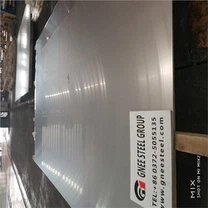
What exactly is cold rolled steel plate?
1. Cold rolling is made from hot-rolled steel as raw material and rolled at room temperature and below the recrystallization temperature. Steel plates produced by the cold rolling process are referred to as cold-rolled plates.
2. The thickness of cold-rolled plates is usually not higher than 8 mm and not lower than 0.1 mm. The thickness of cold-rolled sheet produced by most factories is less than 4.5mm. The thickness and width of cold-rolled plates are changed according to customer orders, and can even be customized.
Related standards:
GB905: cold rolled round steel, square steel, hexagonal steel
GB708: Cold rolled steel plates and strips
|
Grade |
Supply standards | Product size (mm) | use | |
| Nominal thickness | Nominal width | |||
|
GB/T 708 EN 10130:1998 JISG3141:2005 |
0.3~3.0 |
20~1600 |
Suitable for parts formed by deep stamping with general forming knives | |

Performance:
It has high strength, but poor toughness and weldability, is relatively hard, brittle, and has a bright surface.
DC01、DC02、DC03、DC04
|
Grade |
Yield strength RcLMpa | Tensile strength RmMpa | Elongation A80mm% | Plastic strain ratio r90 | Strain hardening index n90 |
|
DC01 |
140~280 |
270~410 |
≥28 |
||
|
DC02 |
140~240 |
270~370 |
≥34 |
≥1.4 |
|
|
DC03 |
120~210 |
270~350 |
≥38 |
≥1.8 |
≥0.18 |
|
DC04 |
120~180 |
270~330 |
≥40 |
≥2.0 |
≥0.20 |
SPCC、SPCD、SPCE
|
Grade |
Yield strength RcLMpa | Tensile strength RmMpa | Elongation A80mm% | Strain hardening index n90 |
|
SPCC |
130~300 |
270~410 |
||
|
SPCD |
120~240 |
270~370 |
≥1.3 |
|
|
SPCE |
120~210 |
270~350 |
≥1.8 |
≥0.18 |
What is the difference between cold rolling and hot rolling?
1. Hot rolling is to produce strip steel after the slab is heated by the rough rolling mill and the finishing mill. After the hot-rolled steel produced by the final finishing mill is cooled to the set temperature by laminar flow, it is rolled into strip coils by the coiler. The cooled steel strip coils are processed by different finishing lines depending on the needs of the user. In layman's terms, the heated steel billet (that is, the red-hot steel in TVs) needs to be rolled several times, and then trimmed and straightened into steel plates. This is called hot rolling.
2. Cold rolling uses hot-rolled steel coils as raw materials, and the hot-rolled oxide scale is removed by pickling, and the finished product appears as a hard coil. Due to cold work hardening caused by continuous cold deformation, the strength and hardness of rolled steel coils increase, while the toughness and plasticity index also decrease simultaneously. Therefore, the stamping performance will further deteriorate, and it can only be used for parts with simple deformation, such as small screws in industry. Cold-rolled steel coil is one of the raw materials for the annealing line of hot-dip galvanizing plants and is widely used. The weight of cold-rolled steel coils generally does not exceed 13.5 tons. By continuously rolling them at room temperature, the inner diameter of the final product is approximately 6.1 meters.