


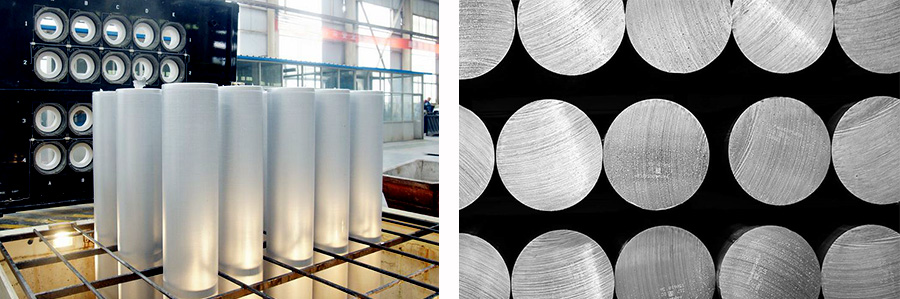
Generally, the die is made of indurative steel or cemented carbide. There are two kinds of conventional methods of extruding aluminum, direct extrusion (same as forwarding extrusion) and indirect extrusion (same as backward extrusion). And there are various ways of categorizing aluminum profiles. According to the aluminum material, the aluminum profile can be classified as 1100 aluminum profile, 6061 aluminum profile, and 6063 aluminum profile. According to different applications, it can be classified as an architectural aluminum profile, industrial aluminum profile, etc.
Treatment of Aluminum Profiles
Heat Treatment
O/F/HXXX/TXXX Temper
Surface Treatment of Aluminum Extrusions
Powder coating
Aluminium with stainless steel look
Anodising(Clear & Stain & Hard coat)
Chemical surface treatment
Mechanical surface treatment
Woodgrain transfer paper printing
PVDF
Brushed, Sandblasted, Polished
Typical Products of Aluminum Profiles
| ● Standard Aluminium Profile ((tube/pipe/bar/angle/corner, L, T, U) ● Custom Aluminium Extrusion (Tailored solutions) ● Aluminium Extruded Frame ● T-slot Aluminum Profile ● Aluminium Solar Panel Frame ● Extruded Aluminum Heat Sink ● Window & Door & Partition Extrusions ● General Aluminum Profile ● Blind & Louvre & Shutter Extrusions ● Aluminium Profile for Ceiling ● Full Aluminium Furniture ● Aluminium Extrusion Profile Accessories ● Assembly Line Aluminum Framework ● Ceiling Aluminium Profiles |
● 6061-T6 Aluminum Association Channel ● 3003 Multi-Channel Aluminium Tube ● Aluminum Extrusions for Big-sized Applications ● 6061-T6 Aluminum Association I Beam ● 6063 Aluminium Profiles with Anodizing Treatment ● Extruded Aluminium Motor Enclosure ● Aluminum Motor Housing ● Aluminium Extrusion Profile Accessories ● Assembly Line Aluminium Framework ● Aluminium Bracket ● Aluminum Handrail ● Aluminium Workbench/Table ● Aluminium Ceiling System ● Aluminium Roll Up Stands |
Benefits of Aluminum Profiles
Industrial aluminum profiles are profiles of aluminum shaped by the process of forcing it to flow through a shaped opening in a predesigned die. The extruded material emerges as an elongated piece with the same profile as the die opening. It is widely used in many industrial areas, it comes with the following benefits:
Easy machining and fabrication
Long life
Excellent corrosion resistance
Wide range of geometries possible
Raw material cost is lower
Eternal recyclable
Good appearance, can be surface treated with different colors
Good mechanical properties
How to choose the right alloy for extruded aluminum profiles?
CHAL makes all the standard and custom aluminum alloys for extrusions. We can provide you with any tempers, shapes and sizes you wanted, by both direct extrusion and indirect extrusion. Both seamless and structured extrusions are available. If your demanded quantity exceeds 40 tons, we also have the ability to create a tailored alloy for you. Bellow table shows you a typical alloy for aluminum extrusions.
| Series | Typical alloy | Characteristics | Applications |
| 1XXX | 1050/1070/1100/1197 Aluminium Alloy | ● Pure aluminium ● Non-heat treatable alloy ● Soft ● Good thermal conductivity |
● Heat transfer ● Automotive ● HVAC/R industries ● Electrical industry |
| 3XXX | 3102/3103/3003 Aluminium Alloy | ● Good corrosion resistance ● Non-heat treatable alloy ● Moderate strength ● Good workability ● 3003 Alloy is 20% stronger than 1100 |
● Architectural application ● Gutters, downspouts, roofing, and siding ● Automotive ● HVAC/R industries ● Outdoor applications ● Other anti-rust application |
| 5XXX | 5083 Aluminium Alloy | ● Easier to weld than 6xxx-series alloys ● Excellent in corrosion resistance in a salt-water environment |
● Marine ship structure applications |
| 6XXX | 6061 Aluminium Alloy | ● High corrosion resistance ● Heat treatable alloy ● Weldable ● Magnesium and silicon alloy ● Good weldability and formability. |
● Construction material ● Automotive components ● Marine components. ● Bridge components |
| 6063 Aluminium alloy | ● Highly corrosion resistant ● Good workability and weldability ● Best appearance after anodizing ● Finer grain structure than 6061 |
● Railway car components ● Tube/Pipe ● Electrical bus conductors ● Architectural applications. |
|
| 6082 Aluminium Alloy | ● Highly corrosion resistant ● Good appearance after anodizing ● High-strength |
● Trucks body ● Floors |
|
| 7xxx | 7075 Aluminium Alloy | ● More zinc than 6061 ● Excellent corrosion resistant ● High-strength |
● High-strength applications ● Aerospace ● Military equipment |
| 7108 Aluminium Alloy | ● Excellent corrosion resistant ● High-strength ● Limited extrudability and formability ● Susceptible to stress corrosion in areas with high stresses |
● Building and transport applications |
Design a New Die for Your Aluminum Profiles
A die is also called a tool or mold. It is made of super-hard tool steels, and the hardness ensures it is suitable for pressing aluminum material through inter opening. The process of pushing an aluminum billet through a steel die to make the final aluminum profile is called extrusion. It determines the shapes of the profile, which is why different tools are used for the production of different aluminum profiles. For example, when we are making solid profiles, we choose a solid die and choose the built-up tool for making the hollow section profile. For making a large-sized aluminum extrusion, we design a die with one opening, and if making a smaller profile, we will create the die with multi chambers. You may find the die is the core part used in the manufacturing of aluminum extrusion.


