
Cold Rolled Steel
DC01 steel is a low-carbon, cold-rolled steel grade specified in the EN 10130 standard, suitable for cold-rolled flat products made from unalloyed low-carbon steel. "DC" stands for "Drawing Cold," indicating its suitability for cold forming applications; "01" represents the base grade in the series, offering standard formability and surface quality suitable for general engineering and manufacturing applications.
This steel grade is produced using a cold-rolling process, where hot-rolled steel is further processed at room temperature. The resulting material exhibits uniform thickness, high precision, and a smooth surface finish.
DC01 Steel Mechanical Properties
DC01 steel has balanced mechanical properties. Compared to structural steels, it offers moderate strength and can be formed into complex shapes without cracking or tearing.
The mechanical properties of DC01 conform to EN 10130. Actual values may vary slightly depending on thickness and rolling direction. Typical values are shown below:
| Yield Strength | ReL / MPa | 140 – 280 | Defines the stress at which plastic deformation begins; suitable for forming operations |
| Tensile Strength | Rm / MPa | 270 – 410 | Moderate tensile strength allows excellent formability |
| Elongation (A80) | % | ≥ 28 – 30 | Indicates high ductility, supporting deep drawing and bending |
| Hardness (Brinell) | HB | 80 – 120 | Soft structure ideal for forming and stamping |
| Elastic Modulus | E / GPa | ~210 | Comparable to other low-carbon steels |
| Poisson's Ratio | ν | ~0.29 | Standard for mild steels, defining deformation behavior under stress |
| Density | ρ / g/cm³ | 7.85 | Consistent with typical carbon steels |
Surface types
The surface quality of cold-rolled flat products is another important aspect of DIN EN 10130. The standard defines various surface finishes, such as smooth or matt, to meet the specific requirements of the end applications. A high surface quality is crucial for subsequent coating processes or decorative applications.
Surface type A
Defects such as pores, small grooves, small warts, slight scratches and slight discoloration that do not impair the suitability for forming and the adhesion of surface coatings are permissible.
Surface type B
The better side must be free of defects to the extent that the uniform appearance of a quality coating or an electrolytically applied coating is not impaired. The other side must at least meet the requirements for surface type A.
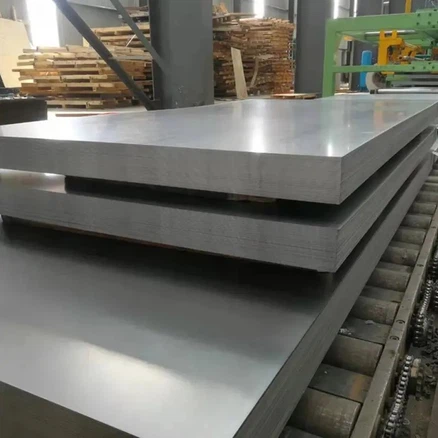
Other cold-rolled steel series grades and specifications table:
| Steel Grade | Yield Strength (MPa) min | Tensile Strength (MPa) min | Elongation | Old Description |
| % min | ||||
| DC01 | ≤280 | 270-410 | 28 | St 12-03 |
| DC03 | ≤240 | 270-370 | 34 | St 13-03 |
| DC04 | ≤210 | 270-350 | 38 | St 14-03 |
| DC05 | ≤180 | 270-330 | 40 | St 15-03 |
| DC06 | ≤170 | 270-330 | 41 | - |
| DC07 | ≤150 | 250-310 | 44 | - |
| Scope of Application |
| DC01 can be used for simple forming work, for example Bending, embossing, beading and pulling. |
| DC03 is suitable for forming requirements like Deep drawing and difficult profiles suitable. |
| DC04 is suitable for high deformation requirements. |
| DC05 is a thermal forming grade, it is suitable for higher forming requirements. |
| DC06 is a grade for special deep drawing, suitable for the higher deformation requirements. |
| DC07, this superior deep drawing quality is suitable for highest deformation requirements. |
Packaging and shipping

FAQ:
1. Does cold rolled steel rust easily?
Cold rolled steel itself does not have corrosion resistance. Without surface treatment, it can rust when exposed to moisture. Common protection methods include oiling, galvanizing, or painting.
2. Can cold rolled steel be galvanized?
Yes, cold rolled steel is often used as the base material for galvanized steel products, as its smooth surface ensures uniform zinc coating.
3. What surface finishes are available for cold rolled steel?
Typical surface finishes include bright finish, matte finish, oiled surface, and dry surface, depending on customer requirements and application needs.
4. What standards are commonly used for cold rolled steel?
Common standards include EN 10130, ASTM A1008, JIS G3141, and GB/T 5213.
5. What is the tensile strength of cold rolled steel?
Tensile strength varies by grade. For example, DC01 typically has a tensile strength of 270–410 MPa, while deep drawing grades have lower yield strength for better formability.
6. Is cold rolled steel easy to weld?
Yes, low-carbon cold rolled steel has good weldability and is suitable for most conventional welding methods.


