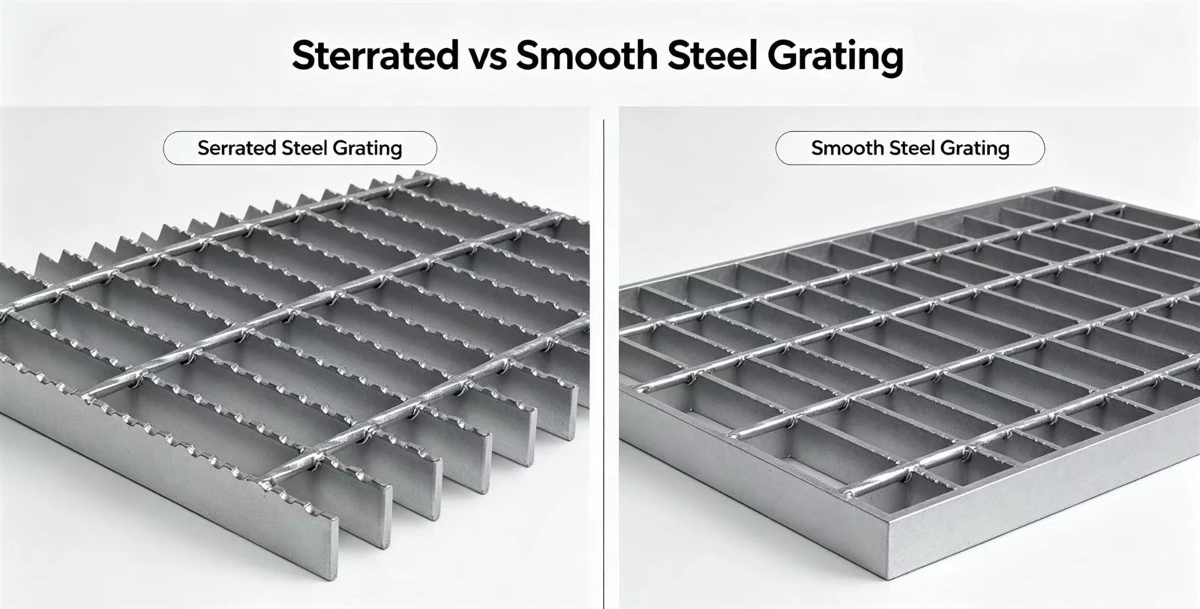
Serrated and smooth steel grating are the two surface options most often compared when an industrial walkway is being specified. The difference looks small – serrated bearing bars carry a row of notches along the top edge, smooth bars do not – but it changes slip resistance, cleaning, cost and even the load calculation. Neither surface is universally better. The right choice depends on whether the walkway will stay dry and clean, or face water, oil, mud and weather.
This guide compares the two surfaces on the factors that actually matter so you can specify the safer, more economical option for your walkway.
How the Two Surfaces Differ
|
Feature |
||
|
Bearing bar top edge |
Flat and continuous |
Notched or toothed (serrations typically every 3–6 mm) |
|
Slip mechanism |
Relies on surface friction between steel and footwear |
Serration teeth mechanically bite into the sole and break up liquid films |
|
Typical environment |
Dry, clean indoor areas |
Wet, oily, muddy, icy or weather-exposed areas |
|
Relative cost |
Lower (no extra forming operation) |
Higher – typically 10–25% more for the same bar size |
|
Cleaning |
Flat edges are easier to wipe or wash |
Debris can lodge in the notches; more attention needed |
|
Load rating |
Uses the full smooth-bar section |
Slightly reduced; must use the serrated load table |
Both types share the same welded construction and the same range of bearing bar sizes, so the choice of surface does not change the fundamental strength of the panel – but it does change the load value used in design, as explained below.
Request Latest Steel Price Today
Slip Resistance: The Decisive Difference
In dry conditions a smooth steel surface already provides reasonable traction, which is why smooth grating has been used for decades in ordinary industrial flooring. The problem appears when water, oil, grease or condensation forms a thin film between the sole and the bar top. On a smooth bar the film reduces contact friction sharply.
Serrated bearing bars solve this with a mechanical effect: the raised teeth press into the shoe sole and scrape the liquid film away from the contact area. Published comparisons report coefficients of friction in the range of 0.7–0.9 for serrated surfaces versus roughly 0.4 for plain steel in dry conditions, and serrated surfaces maintain substantially higher values in wet and oily conditions. Slip-testing methods such as ASTM F1679 (or DIN 51130 for ramps) are commonly used to quantify this difference.
Because real values depend on the bar profile, footwear and contaminant, always ask the supplier for the slip-test report for the exact product rather than relying on generic figures.
Load Capacity: Do Not Assume They Are Equal
The serrations are formed by pressing or shearing material out of the top of the bearing bar. This slightly reduces the effective section near the top compared with a smooth bar of the same nominal height and thickness – commonly estimated at roughly 5–10% depending on the profile and depth of the serration.
For this reason, plain and serrated panels with identical nominal bearing bar sizes should not automatically be given the same allowable load. A proper serrated load table, an engineering calculation, or project-specific verification should always be used. In practice this usually means one of two things:
For light pedestrian walkways, the same bearing bar size is normally acceptable because the design is controlled by deflection rather than by the small section loss; or
For heavily loaded walkways, a serrated bar one step larger in height or thickness may be needed to match the capacity of the smooth configuration.
Cost and Maintenance Comparison
|
Consideration |
Smooth Grating |
Serrated Grating |
|
Purchase price per m² |
Lower |
Higher (extra forming step) |
|
Cleaning effort |
Lower – smooth tops wipe clean |
Higher where mud, chips or sticky residue fill the notches |
|
Slip performance over time |
Constant but low when wet |
High, provided notches are kept clear |
|
Compatibility with coatings |
Any finish |
Hot-dip galvanizing preferred; thick paint can fill the notches and undo the benefit |
|
Footwear wear |
Gentle |
More aggressive; can wear soft soles faster |
Serrated grating is heavier to buy but is often the correct investment where slips are a real risk. The cost of one lost-time slip injury normally exceeds the entire price difference of the grating in the affected area.
Which Should You Choose?
Choose smooth grating when:
The walkway is indoors, dry and regularly cleaned
The process is hygiene-sensitive and open tops are easier to sanitize (some food zones)
Workers stand on the grating for long periods and comfort matters
Budget is the dominant constraint and no wet or oily exposure is expected
Choose serrated grating when:
The walkway is outdoors, or exposed to rain, condensation or wash-down water
Oil, grease, coolant or process liquid can reach the surface
The walkway serves stairs, ramps or inclined surfaces
The area has a documented slip history or strict safety requirements
Foot traffic includes boots with hard soles or contaminated soles (mud, wet chemicals)
A Simple Decision Rule
Will the surface regularly be wet, oily or contaminated? → Serrated
Is the walkway dry and clean more than 90% of the time? → Smooth (or serrated only if specified by safety policy)
Does the walkway include stairs, ramps or wash-down areas? → Serrated
Is the load heavy and the span long? → Select the bearing bar size first, then confirm the serrated load table
Summary
Smooth grating is the economical default for dry interiors; serrated grating is the safety product for wet, oily and outdoor walkways. The two surfaces differ in slip resistance, cleaning, cost and in the load tables that must be used – but not in construction type or available bar sizes. When conditions are doubtful, serrated grating is the conservative choice, and the price premium is small relative to the risk it removes.