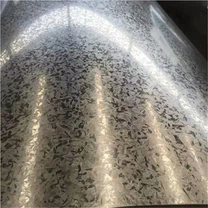


Aluminum coil is a rolled product, produced in a coiled form of a continuous strip, and has an inner diameter and outer diameter. ID from 50 mm to 1000mm. Aluminium alloy grade including 1xxx, 2xxx, 3xxx, 4xxx, 5xxx, 6xxx, 7xxx, 8xxx. But the most common is 1050, 3003, 6061, and 5251 aluminum coil. Thickness from 0.045-80mm, width from 60-2650mm. Common widths of the aluminum coil are 800mm,1000mm, 1250mm,1450mm, and 1500mm
Aluminum coil can be produced from aluminum ingots or other forms of raw aluminum (called cold rolling or direct cast) or from a smelting process directly through rolling (called continuous cast). These sheets of rolled aluminum are then rolled up, or coiled, around a core. These coils are densely packed, making them easier to ship and store when compared to aluminum in sheet form. Coil is used to manufacture an almost unlimited range of components used in an extensive number of industries.
Pure aluminum is too soft for most manufacturing applications. Therefore, most aluminum coil is manufactured and supplied as an alloy. These alloys composed of at least two or more elements of which at least one is aluminum. Aluminum alloys for sheet products are identified by a four digit numerical system which is administered by the Aluminum Association. When alloyed with other metals, aluminum’s mechanical and other properties can be tailored to meet specific requirements for strength, formability, and other properties.
Aluminum coil is available in variable lengths, widths and thicknesses, also referred to as “gauge”. The exact dimensions are determined by the size of the components being made, and the manufacturing process that is used to produce them. Several surface finishes are available including mill, matte and bright. Selection will depend on the use and desired look of the finished part.
Aluminum coil is also offered in various tempers. It may be provided “as fabricated”, called “F” temper, which has no defined mechanical limits, and where no special control has been applied over thermal or work-hardening conditions. Since this approach is subject to variability, it’s usually used for products that are at intermediate stages of production. Strain-hardened is another option, which applies to wrought products which are strengthened by cold-rolling or cold-working. The aluminum may also be annealed, meaning the material has been heated with controlled conditions to produce the desired combination of strength and formability.
Why Choose Aluminum over Other Metals?
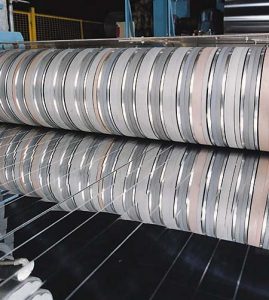
Aluminum being slit to customer specifications
Weight – The biggest advantage that aluminum has over most competing materials with similar properties is its lighter weight. This makes it ideal for applications such as auto, aerospace and others where total product weight is of concern. It’s also more economical to ship as a result.
Workability – aluminum is very malleable, meaning it could easily be formed, stamped or shaped as needed. Its workability and versatility contribute greatly to its popularity. Aluminum is preferred for many manufacturing processes, such as drawing, roll forming, and stamping.
Corrosion Resistance – it also is resistant to corrosion and rust, giving it a significant edge over steel.
Value – aluminum costs considerably less than materials such as copper, allowing manufacturers to keep material expenses down without sacrificing performance.
Recyclability – aluminum is easily recycled allowing it to be used again and again thus reducing environmental impact.
Conductive Properties – Aluminum is a good conductor of heat and electricity. When measured by equal cross-sectional area, electrical grade aluminum has conductivity equal to 62% of electrical grade copper. However when compared using equal weights of both, the conductivity is 204% of copper.
.