

What Is The Composition of Zinc-Aluminum-Magnesium steel?
Zinc-aluminum-magnesium (ZAM) is a high-performance metallic coating applied to steel designed to offer superior corrosion resistance, durability, and heat resistance compared to traditional galvanizing (zinc-only coatings). The coating combines zinc (Zn), aluminum (Al), and magnesium (Mg), which provides unique advantages in various applications.

Composition of Zinc-Aluminum-Magnesium steel
Zinc-Aluminum-Magnesium (ZAM) steel is a type of coated steel that offers enhanced corrosion resistance compared to traditional galvanized steel. The coating composition typically includes:
Zinc (Zn): The primary component, usually comprising around 90-96% of the coating. Zinc provides the primary corrosion protection.
Aluminum (Al): Generally makes up about 1-8% of the coating. Aluminum helps to improve the adhesion of the coating and enhances corrosion resistance.
Magnesium (Mg): Typically present in the range of 1-4%. Magnesium further enhances corrosion resistance, especially in harsh environments.
These elements work synergistically to provide a durable, long-lasting protective layer that is more effective than traditional zinc coatings alone. The exact composition can vary depending on the specific requirements and manufacturer formulations.
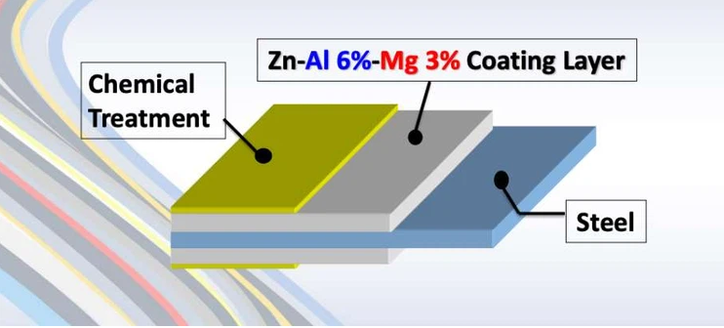
Structure
Zinc-aluminum-magnesium steel consists of a substrate (steel) and a plating layer (zinc-aluminum-magnesium alloy). Al-Mg alloy)
Substrate: Cold-rolled or hot-rolled steel
Plating: Zinc-aluminum-magnesium alloy
-
Composition of the substrate
| Element | Content (%) | Function |
|---|---|---|
| C | ≤ 0.12 | Ensures ductility and weldability |
| Mn | 0.20-0.60 | Improves strength and hardenability |
| Si | ≤ 0.05 | Deoxidizes, reduces inclusions |
| P/S | ≤ 0.025 | Controls contaminants, prevents brittleness |
-
Mechanical properties of the substrate
| Tensile Strength | Yield Strength | Elongation | Hardness |
|---|---|---|---|
| 270~550 MPa | 140~350 MPa | 20%~40% | 60~120 HV |
-
Composition of coatings
| Elemental | content (%) | Function |
|---|---|---|
| Zn | 90-94 | Sacrificial anodic protection, dominant corrosion reaction |
| Al | 4-11 | Formation of oxide film, high-temperature resistance, and barrier protection |
| Mg | 0.2-3 | Promote self-healing, generate an Alkaline protective film |
| Si | 0.1-0.5 | Inhibits the overgrowth of Fe-Al alloy layer |
-
Specifications
|
ltem |
Product Parameter |
|---|
| Type | ZAM Steel Coil |
| Based Metal | Cold Rolled Steel |
| Thickness | 0.5mm-4.0mm |
| Width | <1500mm |
| CoatingThickness | 80-275 g/㎡ |
| Standard | AISI, ASTM, DIN, GB, JIS, BS |
| SurfaceTreatment | Chromatedskinpassed/oiled/non-oiled /dry/Anti-finger printing |
| Applications | Mainlyused in construction,automobiles, homeappliances,hardware accessories, base metal, etc. |
| Package | Standard exportpackage(waterproof paperinside and steel stripsoutside |
ZAM Steel vs. Galvalume Steel
| Feature | ZAM Steel | Galvalume Steel |
|---|---|---|
| Composition | Zinc, Aluminum, and Magnesium | 55% aluminum, 43.4% zinc, and 1.6% silicon |
| Corrosion Resistance | Superior due to the inclusion of magnesium | Very good, but slightly less than ZAM |
| Coating Thickness | Typically thinner due to higher efficiency | Generally thicker for similar performance |
| Durability | High, with excellent edge protection | High, but edges may be more susceptible to corrosion |
| Surface Appearance | Smooth and shiny | Smooth and slightly spangled |
| Cost | Generally higher due to advanced properties | Generally lower compared to ZAM |
| Applications | Roofing, siding, automotive, appliances | Roofing, siding, construction |
| Environmental Impact | Uses less zinc, potentially more eco-friendly | Standard zinc-aluminum coating |
| Paint Adhesion | Excellent | Very good |
| Heat Resistance | Good | Good |
Application scenarios
ZAM coil and sheet Widely used in building roofs, walls, window frames, metal façades, car bodies, chassis, motor housings, brackets, agricultural storage facilities, solar racks, parapet façades, cable bridges, noise barriers, and other applications, with a corrosion resistance of more than 25 years.
1.Construction Industry: Coastal building roofs/walls, steel bridges.
2.Automotive: Chassis guards, inner door panels.
3.Appliances & Energy: Solar racks, air conditioning units.
4.Agriculture and Transportation: Greenhouse skeleton, highway soundproof screen.
FAQ
1. Can Zn-Al-Mg coated steel be welded?
Yes. It is compatible with standard welding methods including MIG, TIG, and resistance welding. Because the coating is thinner than heavy-duty batch galvanizing, it often produces less weld splatter and fumes.
2. How does the hardness of the coating affect processing?
The Zn-Al-Mg coating is generally harder than standard galvanizing. This provides better resistance to surface abrasion and scratching during roll-forming and handling.
3. What is the friction coefficient of this material?
The coating has a lower coefficient of friction compared to pure zinc coatings, which can improve performance during complex stamping or deep-drawing processes.
4. Why is Zn-Al-Mg steel widely used in the solar industry?
Solar mounting structures require a long service life (25+ years) in outdoor environments. Zn-Al-Mg provides the necessary durability and edge protection without the need for the more expensive and time-consuming "post-fabrication" hot-dip galvanizing.
4. Can it be used in coastal environments?
Yes. It is highly effective in chloride-rich coastal regions. The aluminum and magnesium content prevents the "pitting" corrosion often seen in standard zinc coatings near the ocean.