How Long Does Zinc Aluminum Magnesium Steel Last?
Zinc-Aluminum-Magnesium (ZAM) steel typically lasts between 30 to 50 years, providing a service life that is 5 to 10 times longer than traditional hot-dip galvanized steel in the same environment. While standard galvanizing (GI) may show signs of red rust within 5 to 10 years in corrosive settings, ZAM's unique ternary alloy chemistry creates a stable, self-healing barrier that maintains structural integrity for decades. At GNEE STEEL, we supply high-performance ZAM products engineered specifically for projects requiring a 25-to-30-year maintenance-free lifecycle, such as solar mounting systems and coastal infrastructure.
1. Environmental Lifespan: How Does Location Affect Durability?
The lifespan of ZAM steel is primarily determined by its atmospheric corrosivity category (C1 to C5), where it consistently outperforms all other coated steel products. Environmental factors such as humidity, salinity, and industrial pollutants dictate the rate at which any protective coating is consumed.
C1 - C2 (Rural & Indoor): In dry, low-pollution environments, ZAM steel can easily exceed a 50-year lifespan with virtually zero thickness loss.
C3 (Urban & Moderate Industrial): In standard outdoor urban settings, ZAM maintains its surface aesthetics and structural strength for 30 to 40 years.
C4 - C5 (Coastal & Heavy Industrial): In high-salinity areas (within 2km of the ocean), traditional galvanized steel often fails within 7 years. ZAM steel, however, is designed to last 25 to 30 years in these extreme conditions due to its resistance to chloride-induced corrosion.
2. The Chemistry of Longevity: Why Does ZAM Last So Long?
ZAM steel lasts longer because it forms a dense, insoluble mineral layer called Simonkolleite, which is significantly more stable than the porous oxides found on standard galvanized steel. Traditional coatings rely on pure Zinc ($Zn$), which corrodes sacrificially but relatively quickly.
The addition of 1.5% to 11% Aluminum (Al) and 1.5% to 3% Magnesium (Mg) changes the chemical reaction. This "Simonkolleite" layer acts as a permanent shield, reducing the corrosion rate to a fraction of that seen in standard GI or Galvalume (GL) products.
3. Self-Healing Longevity: Protection That Repairs Itself
The ability of ZAM steel to "self-heal" at cut edges and scratches ensures that the lifespan of the entire structure is not compromised by localized damage. In conventional steel infrastructure, the cut ends of a beam are the "weakest links" where rust begins and eventually spreads under the coating.
With ZAM steel, a magnesium-rich aqueous film migrates across the exposed cross-section of a cut or scratch. This chemical migration creates a new protective alkaline film over the bare steel.
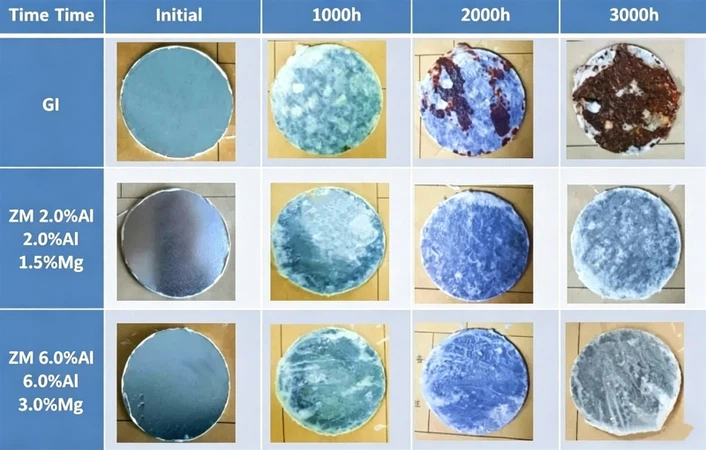
Salt Spray Test (SST) Evidence: Under ISO 9227 standards, ZAM cut edges show no red rust after 3,000 hours of salt spray, whereas traditional galvanized edges fail at 500 hours.
Result: This ensures that the structural bolting points and sheared edges last as long as the flat surfaces of the steel sheet.
4. Hardness and Wear: Resisting Physical Degradation
The high surface hardness of ZAM steel (120–160 HV) prevents the physical thinning of the coating caused by wind-blown sand and mechanical abrasion. A coating's lifespan isn't just about chemical resistance; it's also about physical survival.
In desert or coastal regions, wind-borne particles act like sandpaper. Standard galvanized coatings are relatively soft (60–80 HV) and can be physically worn away over time. ZAM's alloy layer is significantly harder, ensuring the designated coating thickness (e.g., ZM120 or ZM275) remains intact to provide chemical protection for the duration of the project's intended life.
5. Cost-Benefit Analysis: Total Lifecycle Value
While ZAM steel may have a higher initial material cost, it offers the lowest Total Cost of Ownership (TCO) by eliminating the need for repainting and replacement. When calculating the "True Cost" of steel, one must factor in:
Initial Purchase: ZAM is competitive due to the ability to use thinner coatings for equal protection.
Installation: No labor costs for on-site edge painting or touch-ups.
Maintenance: Zero maintenance for 25+ years, compared to traditional steel which may require intervention every 10 years.
Zinc-Aluminum-Magnesium steel is the ultimate solution for long-term structural reliability in the world's most corrosive environments. Whether you are building a solar farm in a saline coastal region or a high-durability industrial warehouse, ZAM provides the longest-lasting protection available in the modern steel market.
GNEE STEEL provides certified ZAM steel coils and profiles that meet international longevity standards (ASTM A1046 / EN 10346). Contact our technical experts today to secure a quote and ensure your project stands the test of time.
- Zinc-Aluminum-Magnesium Steel Test Comparison Chart

Frequently Asked Questions (FAQ)
1. Does ZAM steel really last 30 years in coastal areas?
Yes. Field tests and accelerated salt spray data show that ZAM steel retains its structural integrity for 25 to 30 years in C5-M (Marine) environments, provided the correct coating weight (e.g., ZM275) is selected for the specific distance from the shore.
2. How does the lifespan of ZAM compare to Galvalume (GL)?
ZAM typically lasts 2 to 3 times longer than Galvalume in alkaline and saline environments. While Galvalume is excellent for heat reflectivity, it lacks ZAM's self-healing cut-edge protection and fails in high-pH settings like livestock farms.
3. Will ZAM steel rust if it is scratched during installation?
No. Thanks to its "self-healing" properties, the magnesium in the coating will migrate to the scratch and form a new protective layer, preventing red rust from spreading.
4. What is the expected lifespan of ZAM steel buried in soil?
ZAM performs exceptionally well in soil due to its resistance to varying pH levels. Depending on soil acidity and moisture, it can last 20 to 40 years underground, making it ideal for solar ground-screw piles.
5. Does the thickness of the coating (ZM weight) affect the lifespan?
Absolutely. Just like traditional galvanizing, a higher ZM number (e.g., ZM275 vs. ZM120) indicates a thicker coating and a longer service life. For extreme environments, a higher coating weight is always recommended.
6. Is there a warranty for GNEE STEEL ZAM products?
We provide technical data sheets and material test certificates (MTC) that guarantee our ZAM steel meets the specific chemical and mechanical properties required for long-term durability. Project-specific performance expectations can be discussed with our engineering team.
7. Does ZAM steel lose its anti-corrosive properties at high temperatures?
ZAM is thermally stable up to approximately 300°C. Beyond this point, the eutectic phases in the alloy may begin to change, but for standard outdoor and industrial applications, it maintains its full lifespan.
8. Is ZAM steel's lifespan affected by welding?
Welding destroys the coating at the immediate heat-affected zone. While ZAM has some ability to protect nearby areas, we recommend treating weld joints with a zinc-rich cold galvanizing spray to ensure the 30-year lifespan is maintained across the entire structure.