Is ZAM Steel Better Than Hot-Dip Galvanized Steel?
Zinc-Aluminum-Magnesium (ZAM) steel is significantly superior to traditional Hot-Dip Galvanized (HDG) steel, offering up to 10 times the corrosion resistance and a unique self-healing capability that HDG lacks. While Hot-Dip Galvanizing has been the industry standard for decades, the evolution of metallurgy has introduced ZAM as the high-performance successor. For industries requiring a 30-year maintenance-free lifespan-such as solar energy, coastal infrastructure, and automotive manufacturing-ZAM steel represents the pinnacle of cost-efficiency and durability. At GNEE STEEL, we provide premium ZAM solutions that outlast traditional coatings even in the most aggressive C5-M (Marine) environments.
1. Corrosion Resistance: Why ZAM Outperforms HDG by 10x
ZAM steel provides a much lower corrosion rate than Hot-Dip Galvanized steel because it forms a stable, dense crystalline barrier known as Simonkolleite. Traditional HDG coatings consist of nearly 99% Zinc, which protects steel sacrificially but depletes rapidly in humid or saline conditions.The ZAM coating-typically composed of Zinc with 1.5%–11% Aluminum and 1.5%–3% Magnesium-undergoes a different chemical reaction.
Salt Spray Test Results: According to ISO 9227 standards, ZAM steel can withstand 3,000+ hours of salt spray without red rust, whereas standard HDG often shows failure after only 500 hours.
Environmental Adaptability: ZAM is specifically engineered for high-chloride (coastal) and high-ammonia (agricultural) zones where standard galvanizing fails prematurely.
2. The Self-Healing Phenomenon: Solving the "Edge Rust" Problem
ZAM steel is superior for processed components because it automatically repairs exposed steel at cut edges and drill holes, a feature that Hot-Dip Galvanized steel does not possess. In traditional HDG applications, once the steel is sheared or drilled at a construction site, the exposed edge becomes a high-risk zone for "red rust" creep.
With ZAM steel, the Magnesium-rich ions in the coating become mobile in the presence of moisture. They migrate across the exposed cross-section of the cut edge, forming a new, alkaline protective layer.
Elimination of Post-Treatment: This "self-healing" mechanism removes the need for labor-intensive touch-up painting or cold-galvanizing sprays on-site.
Long-Term Structural Integrity: By protecting the edges, ZAM ensures that the joints and bolting points of a structure-the most critical areas-remain as durable as the flat surfaces.
3. Physical Durability: Hardness and Abrasion Resistance
The alloy coating of ZAM steel is twice as hard as pure Zinc, making it far more resistant to mechanical damage during transportation and installation. On the Vickers scale, a standard HDG coating typically measures between 60–80 HV, while ZAM coatings range from 120–160 HV.
This increased hardness is vital for:
High-Wind Environments: Resisting the abrasive "sandblasting" effect of wind-borne particles in desert or coastal regions.
Solar Trackers: Withstanding the friction and wear in moving parts of a solar tracking system.
Heavy Handling: Reducing the risk of scratches and gouges during the rigorous assembly of large-scale infrastructure.
4. Weight Reduction and Material Efficiency
ZAM steel allows for a "Thinner Coating, Longer Life" strategy, enabling engineers to reduce the total weight of a structure without sacrificing protection. Because the ZAM alloy is so much more effective, a ZM120 coating (120g/m²) can often provide better protection than a heavy Z600 (600g/m²) Hot-Dip Galvanized coating.
Lower LCOE: For solar projects, reducing the steel weight lowers the Levelized Cost of Energy (LCOE) by decreasing shipping costs and simplifying structural support requirements.
Sustainability: Using less zinc for more protection reduces the environmental footprint of the manufacturing process, aligning with modern "Green Steel" initiatives.
5. Cost Comparison: Initial Investment vs. Total Lifecycle Value
While the initial per-ton price of ZAM may be slightly higher than HDG, its Total Cost of Ownership (TCO) is significantly lower due to the absence of maintenance and replacement costs. When evaluating the two materials, it is essential to look at the 25-to-30-year horizon:
| Feature | Hot-Dip Galvanized (HDG) | GNEE STEEL ZAM |
| Maintenance | Periodic repainting required | Zero Maintenance |
| Service Life | 10–15 years (Coastal) | 30+ years (Coastal) |
| Site Labor | High (Edge touch-ups) | Low (Self-healing) |
| Total ROI | Moderate | High |
- Galvanized Aluminum-Magnesium: Comparative Testing
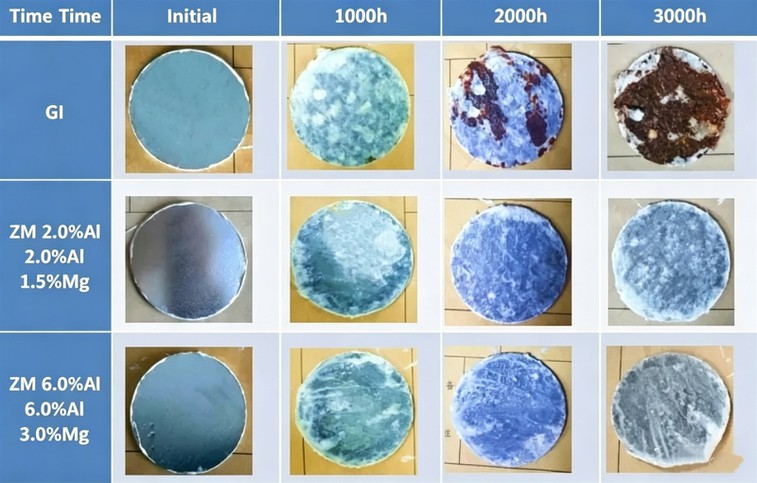
Is ZAM steel better than Hot-Dip Galvanized steel? The answer is a definitive "Yes" for any project demanding longevity, edge protection, and high-performance durability. ZAM is not merely an alternative; it is a technological advancement that addresses the inherent weaknesses of pure zinc coatings.
Frequently Asked Questions (FAQ)
1. Can ZAM steel be used in the same applications as HDG?
Yes. ZAM is a direct, high-performance replacement for HDG in almost every structural application, including solar mounting, HVAC, roofing, and highway guardrails.
2. Does ZAM steel look different from regular galvanized steel?
Initially, ZAM has a smoother, brighter, and more uniform finish with a fine spangle. Over time, as the protective Simonkolleite layer forms, it may take on a duller, dark-grey patina, which is a sign that the anti-corrosive barrier is fully active.
3. How much longer does ZAM last compared to HDG?
In moderate environments, ZAM lasts 3 to 5 times longer. In severe coastal or high-ammonia (agricultural) environments, ZAM can last 10 to 20 times longer than traditional HDG.
4. Is ZAM steel difficult to weld?
ZAM can be welded using all standard methods (MIG, TIG, Spot). It actually produces less zinc fuming than traditional HDG, though parameter adjustments are recommended to account for the aluminum and magnesium content.
5. Why is ZAM better than Galvalume (55% Al-Zn)?
Galvalume is excellent for heat reflection but has poor alkaline resistance and poor cut-edge protection. ZAM provides the "best of both worlds"-the barrier protection of Al-Zn and the superior edge-healing and alkaline resistance of Magnesium.
6. Is ZAM steel suitable for underground use?
Yes. ZAM performs exceptionally well in soil due to its resistance to varying pH levels, making it the ideal choice for ground-screw piles in solar installations.
7. Does ZAM steel help reduce project costs?
Yes. By allowing for thinner coatings and eliminating the need for on-site edge painting and long-term maintenance, ZAM significantly reduces the total lifecycle cost of the project.
8. What standards does GNEE STEEL follow for ZAM production?
Our ZAM products are manufactured in compliance with international standards such as ASTM A1046/A1046M and EN 10346, ensuring the highest quality for global export.