
S320GD Galvanized Steel
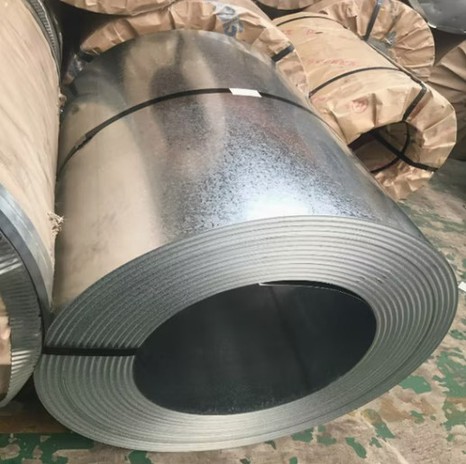
Hot dip galvanized S320GD steel is a high-strength steel. "320" indicates the minimum yield strength of 320 MPa. S320GD steel is widely recognized for its excellent formability, strength, and superior corrosion protection. It can be produced through hot rolling and cold rolling, with a hot dip galvanizing treatment applied. It is extensively utilized in fields such as the vehicle manufacturing and building industries.
GNEE STEEL provides S320GD in the form of coils and strips, ensuring high-quality material for diverse projects.
S320GD steel chemical composition is tailor-made for high durability and corrosion resistance, and is thus great for structural applications. It usually has low carbon, manganese, phosphorus, and sulfur levels to strike a balance between strength and workability. S320GD has improved galvanization properties from the zinc coating, granting higher protection against environmental wear and corrosion when compared with other steel grades like S235 or S355. This particular patch of qualities gives it a set of features that make it an apt choice in construction and in fabrication.
Impact of Chemical Composition on Corrosion Resistance
The relative chemical composition of an alloy determines the corrosion resistance of a compound, the latter functioning in an elementary fashion to protect an alloy against undesirable agents in the external environment. Below is a description of five most common elements and their respective influence on corrosion resistance:
Chromium-Chromium remains the most important element for corrosion resistance in stainless steel. It forms a passive surface oxide layer that inhibits further oxidation. Therefore, alloys generally contain at least 10.5% chromium to afford adequate corrosion resistance.
Nickel – Adding nickel provides stability and toughness and resists pitting and crevice corrosion, especially in marine and acidic environments.
Molybdenum-Molybdenum offers some pitting resistance in chloride environments like seawater. Alloys with 2-3% molybdenum do well in high salinity.
Carbon – Carbon is required for strength; however, high-carbon steels are comparatively less corrosion resistant, as chromium retention is reduced due to the formation of chromium carbides. Carbon content is kept low in stainless steels, such as low-carbon grades, to maintain good corrosion resistance.
Nitrogen-Nitrogen increases stainless steel's resistance to pitting and crevice corrosion, particularly in duplex grades. In addition, nitrogen ensures enhanced mechanical properties, combining strength and ductility.
Features
S320GD galvanized steel could bring the following benefits to your project:
Tough Against Rust – Stands up to weather and doesn't rust easily.
Lasts Long – The zinc layer keeps it going strong for years.
Super Strong – Built to handle heavy-duty jobs without bending or breaking.
Saves Money – Less maintenance needed, so it's cost-effective.
Multi-Purpose – Fits a wide range of uses, from buildings to cars.
Easy to Shape – Flexible enough for all kinds of projects.
Easy to Weld – Works well with welding, so no hassle in production.
Clean Look – Smooth surface that looks good in visible applications.
Comparing Carbon Content in Different Steel Types
| Steel Type | Carbon Content Range (%) | Key Characteristics | Common Applications |
|---|---|---|---|
| Low Carbon Steel | 0.04 – 0.30 | Ductile, easy to weld, low strength | Cutting tools, springs, and masonry nails |
| Medium Carbon Steel | 0.31 – 0.60 | Stronger, harder, less ductile | Automotive parts, gears, axles |
| High Carbon Steel | 0.61 – 1.50 | Very hard, brittle, wear-resistant | Cutting tools, springs, masonry nails |
| Ultra-High Carbon Steel | 0.96 – 2.10 | Extremely strong, brittle | Knives, truck springs, cutting tools |
S320GD Galvanized Steel Chemical Composition
| Element | Maximum Content (%) |
| Carbon (C) | 0.2 |
| Silicon (Si) | 0.6 |
| Manganese (Mn) | 1.7 |
| Phosphorus (P) | 0.1 |
| Sulfur (S) | 0.045 |
Available Steel Grade
|
Available Steel Grade(Ensure weight and support third-party testing) |
||||
|
Steel grade |
Coating |
Yield(MPA) |
Tensile(MPA) |
Elongation(%) |
|
DX51D |
Z,ZF |
-- |
270-500 |
20 |
|
DX52D |
Z,ZF |
140-300 |
270-420 |
22 |
|
DX53D |
Z,ZF |
140-260 |
270-380 |
26 |
|
DX54D |
Z,ZF |
140-220 |
270-350 |
30 |
|
S220GD |
Z,ZF |
220 |
300 |
18 |
|
S250GD |
Z,ZF |
250 |
330 |
17 |
|
S280GD |
Z,ZF |
280 |
360 |
16 |
|
S320GD |
Z,ZF |
320 |
390 |
15 |
|
S350GD |
Z,ZF |
350 |
420 |
14 |
|
S400GD |
Z,ZF |
400 |
470 |
-- |
|
S450GD |
Z,ZF |
450 |
530 |
-- |
|
S500GD |
Z,ZF |
500 |
560 |
-- |
|
Select type Galvanized Steel based on requirements |
||||
FAQ:
1 What does S320GD mean?
S: Structural steel
320: Minimum yield strength (320 MPa)
GD: Supplied in galvanized condition
2 Is S320GD a high-strength steel?
Yes. Compared with common galvanized grades, S320GD is considered a medium to high-strength structural steel suitable for load-bearing applications.
3 What is S320GD galvanized steel mainly used for?
It is widely used in construction structures, steel framing, roofing systems, industrial equipment, and support components.
4 What standards cover S320GD galvanized steel?
S320GD is commonly produced according to international galvanized steel standards such as EN specifications for structural galvanized steel.
5 What is Z275 coating in S320GD+Z275?
Z275 indicates a zinc coating mass of 275 g/m² (total both sides), providing strong corrosion protection for outdoor and structural use.
6 Is Z275 enough for outdoor applications?
Yes. Z275 is suitable for most outdoor environments, including urban and rural areas. For coastal or highly corrosive environments, higher zinc coatings may be recommended.
7 What is the difference between S320GD and lower-grade galvanized steel?
S320GD offers higher yield strength and better load-bearing capacity while maintaining good formability and corrosion resistance.


