Why ZAM Coated C Channel Is Ideal for Solar Projects?
ZAM (Zinc-Aluminum-Magnesium) coated C Channel steel is the most technically advanced structural solution for solar mounting systems, offering up to 10 times the corrosion resistance of traditional galvanized steel. As global solar deployment shifts toward challenging terrains-such as high-salinity coastal zones and ammonia-rich agricultural lands-the demand for materials that exceed a 25-year maintenance-free lifespan has become non-negotiable. At GNEE STEEL, our ZAM-coated C Channels are engineered to provide revolutionary "self-healing" protection, ensuring that every bolt hole and cut edge remains structurally sound in the most aggressive C4 and C5 corrosive environments.

1. What Makes the ZAM Coating Chemically Superior?
ZAM coated C Channels utilize a ternary alloy of Zinc, Aluminum, and Magnesium to create an impenetrable barrier that is significantly more stable than pure zinc. While traditional Hot-Dip Galvanizing (HDG) relies on a 99% zinc layer that depletes sacrificially, ZAM introduces 1.5% to 11% Aluminum and 1.5% to 3% Magnesium into the bath.
This specific chemical composition triggers the formation of a dense, crystalline mineral layer known as Simonkolleite. Unlike the porous white rust found on standard galvanized steel, Simonkolleite is highly insoluble and adherent. Research and Salt Spray Testing (SST) according to ISO 9227 demonstrate that ZAM coatings can withstand 3,000+ hours without red rust, compared to approximately 500 hours for standard HDG. This chemical stability is the primary reason ZAM is the preferred choice for utility-scale solar farms.
2. How Does the "Self-Healing" Property Protect C Channels?
The "self-healing" capability of ZAM coated C Channels is a critical engineering advantage that automatically repairs exposed steel at cut edges, drill holes, and scratches. In solar mounting systems, C Channels undergo extensive processing, including shearing and the punching of thousands of elongated holes for panel mounting and cable management.
On traditional galvanized steel, these bare edges are the first points of failure, often showing red rust within months of installation. With ZAM steel, Magnesium-rich ions in the coating chemically migrate to the exposed cross-section when moisture is present.
Mechanism: A protective alkaline film covers the cut edge, effectively "sealing" the wound.
Benefit: This eliminates the need for labor-intensive post-treatment, such as cold-galvanizing sprays or anti-rust painting at the job site.
Impact: For solar developers, this reduces on-site labor costs by 5% to 10% and ensures the structural integrity of every connection point for the duration of the project's life.
3. Why Is C Channel Geometry the Best Choice for PV Racking?
The cold-formed C Channel profile provides the optimal balance of moment of inertia and material efficiency, allowing for lighter structures that can withstand extreme wind and snow loads. Solar racking must be both rigid enough to prevent module micro-cracking and light enough to facilitate rapid installation.
The return lips (stiffeners) of a C Channel provide significantly higher torsional rigidity compared to a simple U Channel.
Modularity: The open face of the C Channel allows for easy access to fasteners and integrated cable management, protecting DC wiring from UV exposure.
Strength-to-Weight: Utilizing high-strength ZAM grades like S350GD or S450GD, GNEE STEEL can produce C Channels that reduce total steel consumption by 15% to 20% compared to hot-rolled alternatives.
Precision: Cold-roll forming ensures consistent dimensions (web, flange, and lip), which is essential for the seamless assembly of large-scale solar arrays.
4. How Does ZAM Performance Differ in Specialized Environments?
ZAM coated C Channels outperform all other coated steel products in coastal (saline) and agricultural (ammonia) settings, where traditional coatings fail prematurely. 1. Coastal Areas: Chloride ions in salt spray accelerate the consumption of pure zinc. ZAM's aluminum component provides an inert barrier that resists chloride penetration. 2. Agri-PV (Livestock & Farmland): Ammonia generated by animal waste is highly corrosive to Galvalume (Al-Zn) and standard Galvanized steel.
ZAM's specific metallurgical structure is uniquely resistant to high-pH environments, making it the definitive choice for solar integration in agricultural buildings. 3. Desert Regions: The high surface hardness of ZAM (120–160 HV) protects the C Channel from the abrasive "sandblasting" effect of wind-borne sand, maintaining coating thickness over decades.
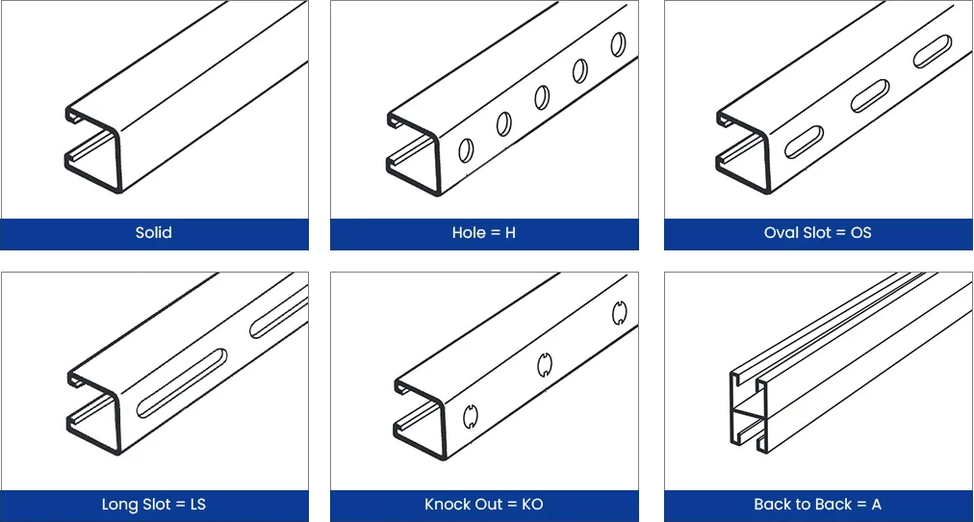
Types of C-Channel Steel
5. Pricing and Investment ROI for ZAM C Channels
While the initial price per ton for ZAM coated C Channels may be slightly higher than standard GI, the Total Cost of Ownership (TCO) is substantially lower. In 2026, the financial bankability of a solar project depends on its ability to reach a 30-year operational life with zero structural maintenance.
At GNEE STEEL, we offer flexible pricing models that account for the long-term ROI:
Material Savings: Due to the superior protection, you can often specify a thinner ZAM coating (e.g., ZM120) to replace a much thicker HDG coating (e.g., Z600), reducing total material weight and shipping costs.
Maintenance-Free Life: Eliminating the need for inspections and repainting cycles can save tens of thousands of dollars in OPEX for a 100MW project.
Market-Linked Quotes: Our pricing for C Channels is dynamic, reflecting current metal indices while providing the best value for high-performance structural steel.
ZAM coated C Channel steel is not just a structural component; it is an insurance policy for the longevity of renewable energy infrastructure. Its combination of chemical stability, self-healing edges, and structural efficiency makes it the logical choice for developers seeking to maximize ROI and minimize risk.
GNEE STEEL is a leading global supplier of ZAM steel solutions. Whether you are designing a coastal solar tracker or a rooftop array, our technical team is ready to provide the precision-engineered C Channels your project deserves.
Frequently Asked Questions (FAQ)
1. Can ZAM coated C Channels be used as ground-mount piles?
Yes. ZAM C Channels are excellent for driven piles. Their high hardness resists abrasion during the pile-driving process, and their resistance to soil-based corrosion (various pH levels) ensures the foundation remains stable for 30+ years.
2. How do ZAM C Channels handle extreme wind loads?
By using high-tensile steel grades (like S450GD) and the torsionally rigid C-profile, our channels are designed to meet strict structural standards. When combined with ZAM's durability, the structure maintains its original strength without the thinning that rust causes over time.
3. Is ZAM steel environmentally friendly?
Yes. Because ZAM lasts significantly longer and requires no maintenance painting (avoiding VOC emissions), it has a much lower carbon footprint over its total lifecycle compared to traditional galvanized steel.
4. What coating weights are recommended for C Channels in solar projects?
For standard inland projects, ZM120 to ZM180 is usually sufficient. For coastal projects within 5km of the sea, we recommend ZM275 or higher to ensure a design life exceeding 25 years.
5. How do I get a quote for customized C Channels?
Simply provide GNEE STEEL with your web height, flange width, thickness, and required hole pattern. We can provide a custom quote that includes the most cost-effective ZAM coating weight for your project's specific location.