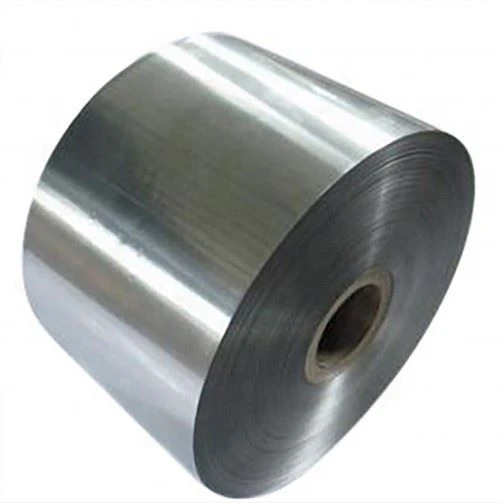

Every hot-dip galvanized coil carries two protective layers. The zinc coating is the main one: it corrodes in place of the steel. On top sits the passivation film, a very thin chemical conversion layer applied on the line. It slows white rust, the loose white product that forms when bare zinc sits in humid air, and it gives paint something to grip. A healthy film is almost invisible. A weak one shows up weeks later as white rust in your warehouse or as paint lifting off a formed part.
Passivation Film On Galvanized Coil
Passivation chemistry is not permanent. The bath ages with every metre of strip it treats: metal ions dissolve in, active chemistry is dragged out, pH drifts. A film that started clear and fast-forming becomes slow, uneven and thin. The coil still looks galvanized when it leaves the mill. It just stops protecting the steel as long as it should.
1. Five Signs The Film Is Not Doing Its Job
|
What you see |
What it usually means |
What to do |
|
Dull, patchy or yellow-brown surface instead of even bright zinc |
Film build uneven; usually zinc and iron build-up in the bath |
Ask for the batch salt spray report before accepting |
|
White powder inside the coil wraps after a few weeks |
Film too thin to stop white rust |
Photograph, quarantine the coil, raise a claim |
|
Grey dust that wipes off the surface |
Film poorly formed, or dried too hot too fast |
Reject; adhesion and paint bonding are both lost |
|
Colour steps between coils from the same order |
Bath concentration drifting during the run |
Compare coil tags and question the lot |
|
Paint or powder peeling after forming |
Film missing, or incompatible with the paint system |
Check the surface treatment on the mill certificate |
2. Three Tests That Settle The Argument
|
Test |
Standard |
What a healthy result looks like |
|
Neutral salt spray (NSS) |
GB/T 10125, ISO 9227, ASTM B117 |
Passivated zinc commonly reaches 72 hours or more before white rust; unpassivated zinc can stain in under 8 hours |
|
Coating mass |
EN ISO 1460 or ASTM A90; spot thickness by EN ISO 2178 |
Meets the ordered designation, for example Z100 to Z275 |
|
Coating continuity |
Copper sulfate test per ISO 1461 or GB/T 13912 |
No red copper deposit within the specified number of dips |
One caution: salt spray hours are a laboratory comparison, not a service life. Use them to compare two lots tested the same way, not to predict years outdoors.
3. Why The Bath Ages, And How The Film Shows It
Four things wear a passivation bath out, and each leaves a mark on the coil.
Metal ions build up. Zinc and iron dissolve in as strip passes. Iron is the damaging one: suppliers commonly hold it to roughly 300 to 1000 mg/L, above which the film turns yellow-brown and patchy. Zinc is tolerated far higher, but it dulls the deposit.
Active chemistry is dragged out. Every coil carries solution away with it. Concentration falls and the film gets thinner.
pH drifts out of the window. Trivalent passivates typically run around pH 1.6 to 2.2. Too acidic and the bath attacks the zinc; too mild and the reaction barely happens.
Drying goes wrong. Dry too hot or too fast and the film cracks microscopically, opening paths for moisture to reach the zinc.
The practical way to catch all four is a reference panel, run on a fixed schedule and compared against a fresh-bath panel. Many lines treat a consistent drop of about 15 percent in film formation speed as the point to correct or replace the bath. Waiting until salt spray fails means the weak coils have already shipped.
4. What We Check Before A Coil Leaves
Coating weight measured per lot against the ordered designation and filed against the coil number.
Passivation roll-coated on the line, then dried and cooled before coiling; film type stated on the mill certificate.
Salt spray panels run per production batch, results available before shipment.
Every coil tagged with a batch number, so a later question traces to a production record.
Sea-freight packing: moisture-barrier wrapping, steel strapping, edge protection, coils on skids and blocked in the container.
Third-party inspection before shipment is welcome; you may send your own inspector.

FAQ
Q: Is a chromium-free film as good as a trivalent chromium one?
A: In most applications yes. Chromium-free films can match or exceed conventional ones in salt spray, and they are the required choice for RoHS and ELV restricted markets. Film build and bath control usually matter more than which chemistry you specify.
Q: Can I skip passivation if the coil will be painted?
A: No. The film is what the paint bonds to. Skipping it costs adhesion and leaves the coil open to white rust in storage and transit.
Q: How long does the film protect a coil in storage?
A: It is not a storage guarantee. Keep coils dry, ventilated and off the floor. Condensation trapped inside the wraps starts white rust, not the age of the film.