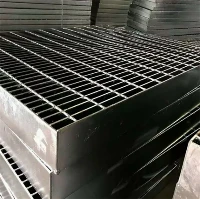
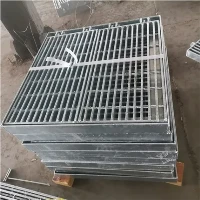


Platforms, walkways and stair treads all use the same product family but they do not fail for the same reasons. A platform fails by overload, a walkway fails by feeling springy underfoot, and a stair tread fails by slipping at the nosing. Q235B galvanized steel grating is specified for all three, and this page shows how to pick the right configuration for each - so one material covers a whole access system without over- or under-specifying any part of it.
Q235B Galvanized Steel Grating
The Material Baseline
Q235B is a carbon structural steel under GB/T 700: yield strength not less than 235 MPa and tensile strength typically 370–500 MPa for thickness up to 16 mm. It welds cleanly, which matters because welded grating relies on forged joints between bearing bars and cross bars, and it costs far less than stainless steel. After fabrication, panels are hot-dip galvanized to ASTM A123 / ISO 1461 / GB/T 13912, giving a bonded zinc coating of typically 85 µm (≈610 g/m²) that protects edges, cut-outs and welds.
Matching the Grating to the Location
|
Location |
Governing criterion |
Recommended configuration |
|
Equipment platforms |
Uniform and point loads, span |
19-W-4 pattern, bearing bars 32×5 to 50×5 mm, smooth or serrated |
|
Walkways and catwalks |
Deflection comfort, slip resistance |
19-W-4 or 11-W-4, deflection limited to ~1/4 in under 100 psf, serrated outdoors |
|
Stair treads |
Slip resistance at the nosing, tread depth |
Serrated bars plus a welded anti-slip nosing bar, end carrier plates with bolt holes |
|
Drainage and trench covers |
Open area, removable panels |
19-W-4 with banded edges and lift handles |
The most common mistake is specifying one panel type for an entire structure. A walkway sized only for strength will pass every load check and still be rejected by operators, because a deck that deflects more than about 1/4 in under normal walking load feels unsafe. Deflection, not strength, governs walkway comfort - so walkway panels are normally chosen one size deeper than pure strength requires.
Request Latest Steel Price Today
Stair Treads Need Their Own Details
Stair treads take concentrated heel loads at the front edge and are the highest-risk slip location on any structure. We fabricate them with serrated bearing bars, a welded nosing bar at the leading edge, and end carrier plates drilled for bolting or prepared for welding. Tread width is normally 240–300 mm, with the panel length cut to the stair width. Because serrations remove material from the top of the bar, a serrated tread is specified roughly 1/4 in deeper than a smooth bar for equal capacity.
Practical Details That Decide the Order
Open area: the 19-W-4 pattern gives roughly 80% open area, so liquids, chips and dust fall through and sprinkler spray passes - a real advantage over checker plate.
Anti-slip: choose serrated for wet, oily, outdoor or inclined surfaces; plain is acceptable for dry interiors.
Fixing: saddle clips (typically four per panel) or weld-on fixing, plus banded ends to stop bar ends from splaying under trolley wheels.
Safety codes: openings and gaps are checked against EN ISO 14122-2 and the applicable local walkway rules; tell us your market and we will flag any gap or nosing requirement.
Coating: hot-dip galvanized after fabrication to ASTM A123 / ISO 1461 / GB/T 13912, with coating thickness reports supplied per lot.
Documents and Delivery
Every shipment can be supplied with mill certificates, dimensional inspection records and coating thickness reports, packed on pallets with steel strapping and waterproof wrapping for container shipment. Panels are cut, banded and shaped to drawing, including cut-outs around columns and pipes.
FAQ
Q: Smooth or serrated for an outdoor walkway?
A: Serrated. Water, oil and frost all reduce grip, and serrated bars are the standard choice outdoors, on ramps and near wash-down areas.
Q: How is grating fixed to the supporting steel?
A: Usually with saddle clips - typically four per panel - or welded directly to the support, with banded ends where trolleys roll across the panel.
Q: Can you cut panels around columns and pipes?
A: Yes. Panels are cut, banded and shaped to your drawings, including cut-outs and removable sections for maintenance access.