

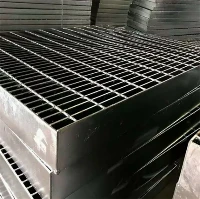
Serrated steel grating is a common specification for industrial platforms because it combines structural load capacity with anti-slip performance. But "serrated grating" alone does not define a product – the platform engineer still has to choose the bearing bar size, material grade, mesh pattern, serration profile, finish and fabrication details. Get these right and the platform is safe and economical; get them wrong and the grating may deflect, corrode early, or fail to grip when it matters.
This guide walks through the selection in the order a platform is usually designed: load first, then material, surface, mesh, finish and fabrication.
Step 1. Define the Load and the Span – This Sets the Bearing Bar
The bearing bars are the load-carrying members, and their height is the single most important dimension. A taller bar resists bending far better than a shorter one of the same thickness, so the allowable span grows with bar height.
|
Bearing Bar Size |
Typical Duty |
Typical Clear Span |
|
25×3 mm |
Light duty, walkways |
~600–900 mm |
|
30×3 mm |
Standard platforms |
~700–1000 mm |
|
30×5 mm |
Standard industrial platforms |
~900–1200 mm |
|
40×5 mm |
Heavier platforms and equipment areas |
~1000–1500 mm |
|
50×5 mm and above |
Heavy-duty process platforms |
1500 mm and beyond |
The values above are indicative only. Load capacity is governed by the live load, the clear span between support beams, the support condition and the deflection limit (commonly L/200 for industrial platforms per ANSI/NAAMM MBG 531).
Request Latest Steel Price Today
Serrated-specific point: serrations remove material from the top of the bar and reduce the effective section by roughly 5–10% compared with a smooth bar of the same nominal size. Always use the manufacturer's serrated load table, not the smooth one. Where the platform is heavily loaded, choose one bar size larger in height or thickness than the smooth-bar calculation would suggest.
Step 2. Choose the Material Grade
Serrated grating is normally made from carbon steel or stainless steel.
|
Material |
Standards |
Best For |
|
Q235 / Q235B |
GB |
General indoor and outdoor platforms |
|
ASTM A36 |
ASTM |
International projects, structural platforms |
|
SS400 |
JIS |
Export projects to Asia and the Middle East |
|
S275JR |
EN |
European projects |
|
Stainless 304 / 316 |
ASTM |
Corrosive, marine, chemical and hygiene-critical platforms |
For outdoor or humid platforms, specify hot-dip galvanizing after fabrication; for aggressive chemical or marine service, stainless steel avoids the maintenance of a coated carbon steel surface.
Step 3. Select the Serration Profile
Serrated bearing bars are produced in different tooth profiles, and the right one depends on the traffic and the contaminant:
Semicircular serrations – a general-purpose anti-slip surface, suitable for most walkways and platforms
Trapezoidal serrations – a more open tooth form that sheds mud and debris more easily
Intermittent serrations – teeth in sections along the bar, used where a balance of grip and cleanability is needed
For most industrial platforms a standard semicircular serration is sufficient. Where boots carry mud, or where wash-down is frequent, discuss the profile with the supplier. Serration on one edge is standard; double-edge serration gives more grip but is harder to clean and is rarely needed on horizontal platforms.
Step 4. Choose the Mesh Pattern
The mesh is defined by two pitches:
Bearing bar pitch (spacing between load bars) – commonly 30 mm or 40 mm center to center. Closer spacing (30 mm) supports more concentrated loads and gives a finer walking surface; 40 mm is more economical where loads are uniform.
Cross bar pitch (spacing between transverse bars) – commonly 50 mm or 100 mm. The cross bars hold the panel square and distribute local loads; they do not carry the main bending load.
For platform flooring the common industrial combination is 30×5 mm bearing bars at 30 mm pitch with cross bars at 50 or 100 mm. If small tools or parts must not fall through, a closer bearing bar pitch or a different panel type should be considered.
Step 5. Select the Surface Finish
|
Finish |
When to Use |
|
Hot-dip galvanized (recommended for most platforms) |
Outdoor, humid, wash-down or mildly corrosive service; protects welds and serrated edges |
|
Painted / powder coated |
Dry interior platforms; ensure the coating does not fill the serration notches |
|
Mill finish (black) |
Temporary or indoor-only structures |
|
Stainless (304/316) |
Marine, chemical or food environments where coating maintenance is not acceptable |
Galvanize after all cutting, serrating, banding and welding is complete so the zinc protects every notch, weld and cut edge.
Step 6. Specify the Fabrication Details
A platform grating order is rarely a bare panel order. Confirm these items with the supplier:
Edge banding – closing bars welded around the perimeter strengthen the edges and give a finished, safe edge
Cutouts and notching – around columns, pipes, equipment bases and handrail posts; best done at the factory from approved drawings
Fixing – saddle clips or G-clamps for removable panels; welding for permanent fixing
Removable sections – above valves, sumps and equipment that needs access without cutting the floor
Stair treads – if the platform is reached by stairs, serrated treads with nosing and end plates are normally specified
Marking and inspection – panels marked for location, with material certificates and third-party inspection (SGS, BV, TUV) available before shipment
Summary Selection Checklist for Your RFQ
|
Item |
Your Input |
|
Application |
Platform type, size, location (indoor/outdoor) |
|
Clear span between supports |
mm |
|
Design load / deflection limit |
e.g. 4 kN/m² live load, L/200 |
|
Bearing bar size |
height × thickness, e.g. 30×5 mm |
|
Bearing bar pitch |
e.g. 30 mm |
|
Cross bar pitch |
e.g. 50 or 100 mm |
|
Serration profile |
Standard / semicircular / per drawing |
|
Material & standard |
Q235 / ASTM A36 / SS400 / stainless |
|
Finish |
Hot-dip galvanized / painted / mill |
|
Fabrication |
Banding, cutouts, clips, treads, drawings |
|
Quantity & panel sizes |
List or drawing |
Summary
Choosing serrated steel grating for an industrial platform is a six-step process: size the bearing bars to the span and load, select the material grade, pick the serration profile, set the mesh pitch, choose the finish, and confirm fabrication details. The most common mistake is to order "serrated grating" without specifying the bearing bar size – the second most common is using a smooth-bar load table for a serrated panel. Cover both and the platform will be safe, code-compliant and economical.


