
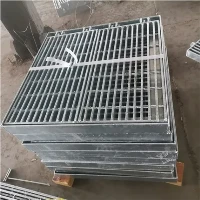


Heavy-duty load bearing is not a marketing label - it is the result of three decisions: the steel grade, the bearing bar section, and the clear span. Q235B galvanized steel grating combines a reliable structural carbon steel with hot-dip galvanizing, and when the bearing bars are sized correctly it carries forklifts, pallet trucks and H-10 / H-20 vehicle traffic rather than just foot traffic. This article explains what actually controls heavy-duty capacity and how to specify it.
Q235B Galvanized Steel Grating
Why Q235B Is the Base Material
Q235B is a Chinese carbon structural steel grade under GB/T 700. For material up to 16 mm thick, the specified yield strength is not less than 235 MPa and tensile strength is typically 370–500 MPa, with elongation around 26%. That combination gives predictable bending behaviour, good weldability for forged cross-bar joints, and a material cost well below stainless steel - which is why it is the default grade for industrial grating worldwide. Its equivalents are often cited as ASTM A36 and S275JR, but the ordering document should always name one standard and one grade.
What Makes Grating "Heavy-Duty"
The designation (for example 19-W-4) describes spacing only: bearing bars at 1-3/16 in (30 mm) centres, welded construction, cross bars at 4 in (100 mm) centres. Capacity is raised by making the bearing bars deeper and thicker:
|
Level |
Bearing bar depth |
Bearing bar thickness |
Typical duty |
|
Standard walkway |
3/4 – 1-1/4 in (20–32 mm) |
3 mm |
Pedestrian, 100 psf class |
|
Industrial platform |
1-1/4 – 2 in (32–50 mm) |
5 mm |
Equipment, trolleys, maintenance loads |
|
Heavy-duty |
2 – 6 in (50–150 mm) |
1/4 – 1/2 in (6–12 mm) |
Forklifts, H-10 / H-20 vehicle traffic |
Deeper bars raise the section modulus steeply, so capacity rises much faster than weight. Cross bars are also upsized - typically 5/16 in twisted square or round bar - so the forged joints survive repeated rolling loads.
Request Latest Steel Price Today
Published Load Reference
The table below gives published reference values for the widely used 19-W-4 pattern with 1-1/4 × 3/16 in bearing bars, calculated on an A36-type allowable stress basis at an L/240 deflection limit:
|
Clear span |
Safe uniform load |
Approx. panel weight |
|
3 ft |
~1,619 psf |
~8.9 psf |
|
4 ft |
~911 psf |
~8.9 psf |
|
5 ft |
~583 psf |
~8.9 psf |
These figures are indicative planning values, not a design certificate. Actual capacity depends on the bar section, the specified grade (Q235B has a slightly lower yield than A36), the deflection criterion, and whether the load is uniform, concentrated or a wheel load. For vehicular traffic, always select against the real wheel load and contact area, and ask for our per-span load table before ordering.
One detail that changes specifications: serrated grating pays a load penalty. Because the teeth cut into the top of the bearing bar, a serrated bar must be roughly 1/4 in deeper than a smooth bar to carry the same load. Specify serrated columns, not smooth ones, when slip resistance is required.
Corrosion Protection
Heavy-duty grating is galvanized after fabrication, so cut ends, welds and edges are all coated. We hot-dip galvanize to ASTM A123 / ISO 1461 / GB/T 13912, with a typical average zinc coating of 85 µm (≈610 g/m²) or heavier on request; one micrometre of zinc equals about 7.14 g/m². The result is a metallurgically bonded layer that survives the abrasion of wheels and pallets far better than paint.
GNEE STEEL Supply Scope
Bearing bars 20 × 3 mm up to 150 × 12 mm, spacing 30 / 40 mm or custom
Welded (pressure-welded) construction to ANSI/NAAMM MBG 531, heavy-duty designs to MBG 532 and YB/T 4001.1-2019
Smooth or serrated surface, banded ends, cut-outs and shaped panels to drawing
Mill certificates, coating thickness reports and export packing on pallets
FAQ
Q: What bearing bar size do I need for forklift traffic?
A: Heavy-duty sections of 2 in depth and above at 1/4–1/2 in thickness, selected against the actual wheel load and contact area - ask for our load table, not a rule of thumb.
Q: Is serrated grating weaker than smooth?
A: Yes. Serrations cut into the bar, so a serrated bar must be about 1/4 in deeper than a smooth bar to carry the same load.
Q: Can Q235B replace ASTM A36 in a grating specification?
A: The two are commonly treated as equivalents, but Q235B (235 MPa yield) sits slightly below A36 (250 MPa yield). Name one grade on the purchase order and let us confirm the load check for it.


