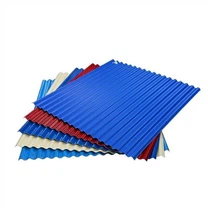


Introducing coated steel plates:
Coated steel plates are lightweight, beautiful, have good anti-corrosion properties, and can be directly processed. They provide a new type of raw material for the construction industry, shipbuilding industry, vehicle manufacturing industry, furniture industry, electrical industry, etc., and play a role in replacing steel with steel. Wood, efficient construction, energy saving, pollution prevention and other good effects.

Color-coated steel plates using galvanized steel plates as the base plate, in addition to zinc protection, the organic coating on the zinc layer plays a covering and isolation role, which can prevent the steel plates from rusting and has a longer service life than galvanized steel plates. According to reports, the coating The service life of steel plates is 50% longer than galvanized steel plates.

However, in different regions and different use parts, the service life of color-coated panels with the same galvanizing amount, the same coating, and the same coating thickness will be very different. For example, in industrial areas or coastal areas, due to the action of sulfur dioxide gas or salt in the air, the corrosion rate is accelerated and the service life is affected. In the rainy season, if the coating is soaked by rain for a long time, or in areas where the temperature difference between day and night is too large and condensation is likely to occur, it will corrode quickly and its service life will be reduced.

Buildings or factories made of color-coated steel plates have a longer service life when they are often washed by rainwater. Otherwise, their use will be affected by the action of sulfur dioxide gas, salt and dust. Therefore, when designing, if the slope of the roof is larger, it will be less likely to accumulate dust and other dirt, and the service life will be longer; for those areas or parts that are not frequently washed by rain, they should be washed regularly with water.
Color coated steel plate classification
Color-coated steel plate products can use cold-rolled substrates, hot-dip galvanized substrates and electro-galvanized substrates.
The types of color-coated steel plates classified by substrate are as follows:
1. Cold rolled substrate color coated steel plate
Colored plates produced from cold-rolled substrates have a smooth and beautiful appearance and have the processing performance of cold-rolled plates; however, any small scratches on the surface coating will expose the cold-rolled substrates to the air, causing the iron to be exposed quickly. Generates red rust. Therefore, this type of product can only be used for temporary isolation measures and indoor materials with low requirements.
2. Hot-dip galvanized color-coated steel plate
The product obtained by coating organic coatings on hot-dip galvanized steel panels is hot-dip galvanized color-coated panels. In addition to the protective effect of zinc, the hot-dip galvanized color-coated sheet also has an organic coating on the surface that protects and prevents rust, and has a longer service life than hot-dip galvanized sheets. The zinc content of hot-dip galvanized substrates is generally 180g/m2 (double-sided), and the zinc content of hot-dip galvanized substrates for exterior buildings is up to 275g/m2.
3. Hot-dip aluminum-zinc color-coated sheet
Upon request, hot-dip aluminum-zinc steel sheets can also be used as color-coated substrates (55% Al-Zn and 5% AI-Zn).
4. Electro-galvanized color-coated sheet
The product obtained by using an electro-galvanized sheet as the substrate, coating it with organic paint and baking it is an electro-galvanized color-coated panel. Since the zinc layer of the electro-galvanized sheet is thin and the zinc content is usually 20/20g/m2, this product is not suitable for use. Make walls, roofs, etc. outdoors.
However, due to its beautiful appearance and excellent processing properties, it can be mainly used in home appliances, audio, steel furniture, interior decoration, etc.
5. Paint
Coating is an organic substance in a fluid or powder state. When applied to a substrate, it dries and solidifies to form a thin film that evenly covers and adheres well.
Its main properties are protective (such as moisture resistance, water resistance, weather resistance, chemical resistance, etc.) and decorative (with various colors and gloss).