


For a long time, steel has been the foundation of the automobile industry. Among general body structural materials, steel materials account for more than 85%. Although the use of aluminum alloys, magnesium alloys, plastics and composite materials in automobile manufacturing continues to increase, high-strength steel is still the current choice due to its advantages such as high weight reduction potential, high collision absorption energy, high fatigue strength, and high formability. Basic structural material for automobile bodies. Such steel plates come from Europe! EU emission standards have forced them to reduce the weight of their cars.
Hot forming process brings revolutionary breakthrough for high-strength steel applications
Although conventional high-strength steel has high tensile and yield strength, it not only has poor deformation ability at room temperature, but also has a narrow plastic deformation range, requires high stamping force, and is prone to cracking. At the same time, the springback of the parts after molding increases, resulting in poor dimensional and shape stability of the parts. Therefore, traditional forming methods are difficult to solve the problems encountered in high-strength steel plates in automobile body manufacturing, and hot forming technology is solving these problems.
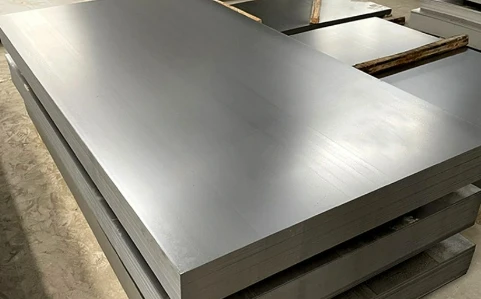
The thermoforming process is to heat high-strength steel plates at room temperature to 880-950°C, then send them into a mold with an internal cooling system for stamping, and finally cool them quickly to harden the stamped parts. Thermoforming technology facilitates precise control of part dimensions, greatly improves strength and reduces part weight.
High-strength steel parts made by thermoforming process are distributed in front longitudinal beams, rear longitudinal beams, A-pillars, B-pillars, central tunnel, front wall, floor beams and other parts. These parts are body safety structural parts and bear the main responsibility of protecting the passenger compartment. Therefore, they are required to have high mechanical properties, molding properties, welding properties, especially high intrusion resistance and energy absorption capabilities.
The thicker the car body steel plate is, the better. "Thin" and "strong" is the trend.

The thicker the car body steel plate is, the better. Too thick a steel plate will not only increase the weight of the car body, affect fuel economy and handling stability, but also cause the passenger compartment that should be protected to bear more burden due to unreasonable strength distribution. It has too much energy-absorbing responsibility, so it cannot play a good protective role.
Therefore, the design of modern automobile body follows the demand design principle of "use good steel on the cutting edge". On the one hand, the vehicle body is lightweighted to the maximum extent while ensuring that the collision safety of the vehicle body is met; on the other hand, through the reasonable distribution of the strength of the body parts, the purpose of absorbing energy in different parts and protecting the passenger compartment is achieved.
"Variable cross-section" and "variable strength" perfectly reconcile the "contradiction" between collision safety and lightweight
High-strength steel using hot forming technology provides a powerful "weapon" for modern car body design. Its good mechanical properties improve the safety of the car and the strength and stiffness of the car body. At the same time, it realizes the lightweight of the car body and maintains or even improves the dynamic performance of the vehicle. , acoustic performance, handling stability, fuel economy, etc. In the hot forming process, there are two key "changes" - "change in cross-section" and "change in strength" that allow the body steel plate to become "thin" and "strong".
The purpose of changing the cross-section is to maximize the lightweight of the car body through changes in cross-section thickness while ensuring that the collision safety of the car body is met. Through the precise control of the rollers during rolling, it is possible to achieve continuous changes in the thickness of the steel plate. Compared with traditional parts with the same material thickness and laser welded parts, the continuously variable cross-section steel plate parts not only have the same collision safety, but also And the lightweight effect is significant.
Variable strength achieves the purpose of absorbing energy in different parts and protecting the passenger compartment through the reasonable distribution of the strength of body parts. For example, the new Touran L uses variable-strength thermoforming technology in the rear longitudinal beam parts. In the event of a rear-end collision, the rear of the rear longitudinal beam can deform and absorb energy, while the high strength of the front of the rear longitudinal beam ensures key components such as the passenger compartment and fuel tank. The parts are not squeezed. Its structural optimization of the body is a direct reflection of German quality. Since variable-strength thermoforming technology requires more complex mold design and process assurance than ordinary thermoformed parts, only a few global automotive companies have mastered it.
With the application of high-strength steel and advanced processing technology, lightweight body design has become the mainstream of modern automobile design. Under the guidance of more advanced concepts, the safety of the car is not only not lost due to the weight reduction of the car body, but can also protect the integrity of the passenger compartment to a greater extent in the event of a collision. The lightweight vehicle body can improve control accuracy, effectively reduce fuel consumption and reduce vehicle costs.


